

Category: General

  • Gender misinformation and rape culture

    Gender misinformation and rape culture

    Media scholars view gendered disinformation as “a subset of misogynistic abuse and violence against women, as false or misleading gendered and sexualized narratives, often with an intent and coordination to prevent women from participating in the public sphere and harm their reputation.”[1]

    Gendered disinformation differs from general disinformation by violating women’s personal boundaries, promoting sexual and physical violence against women, etc. Therefore, gendered disinformation has multiple overlaps with rape culture, i.e., a culture in which sexual violence and other types of sexual abuse are normalized and embedded in a broader context. In such a culture, a woman’s sexual life and corporeality is either directly reduced to an object of male property or, through condemnation as immoral, is subject to attempts of social control, and thus also objectified.

    See more about rape culture in the article by Evhenia Dyshleva

    An example of gendered disinformation in Ukraine is the story of war correspondent Iryna Sampan. After she signed a statement by the NGO Women in Media against the Uncensored Calendar project (nude photography by Channel 5 journalists to raise funds for the army), Iryna was attacked by the right-wing radical group C14 and national russian pro-Kremlin media. The former tried to buy nude photos of her from her friends and sent negative messages about her to her husband, while the latter called her an “escort” and “Zaluzhny’s lover.”[2] In both cases, the mere existence of a woman’s sexual life was used to discredit her position and herself in order to intimidate and control her.

    Such stories are seen not only in Ukraine. In 2021, fake nude photos of Foreign Minister Annalena Baerbock appeared in the German Internet segment.[3] In both cases, the fight against gendered disinformation should go beyond merely refuting fakes – it should foster the understanding of why the body and sexual agency belong to a woman only, the acceptance of different forms of sexual behavior, and dismantling the stereotypes of “female” and “male.” It is also important to counteract online and offline harassment at all levels and provide victims with comprehensive support.

    However, gendered disinformation can also be viewed more broadly as the disinformation around feminism and related topics (LGBT+ rights), the instrumentalization of gendered narratives, or women themselves to advance political and other goals.

    An example of such disinformation is the story of Olena Zelenska’s photo shoot for Vogue magazine. American conservative commentators reacted to it by spreading the idea that this photo session was funded by U.S. taxpayers and that it was a misuse of their money, and therefore, aid to Ukraine should be cut. In fact, U.S. aid comes as armaments, and the photo shoot was in no way related to that. Another, less obvious example was some Western feminists’ criticism of this photo session as glamorous and objectifying, on the sole basis that the photo was published in a glossy magazine. Even though there were no signs of objectification or other misogynistic aspects in the photos, as the first lady was in a subject position, in closed and formal clothes, in the setting of the presidential administration. However, a person who has not seen her, but has only read Western feminist criticism, may get a stereotypical (and false) impression. This is yet another example of gendered disinformation, although not malicious, but rather stemming from a dogmatic worldview and conviction of one’s truth despite the facts of reality.
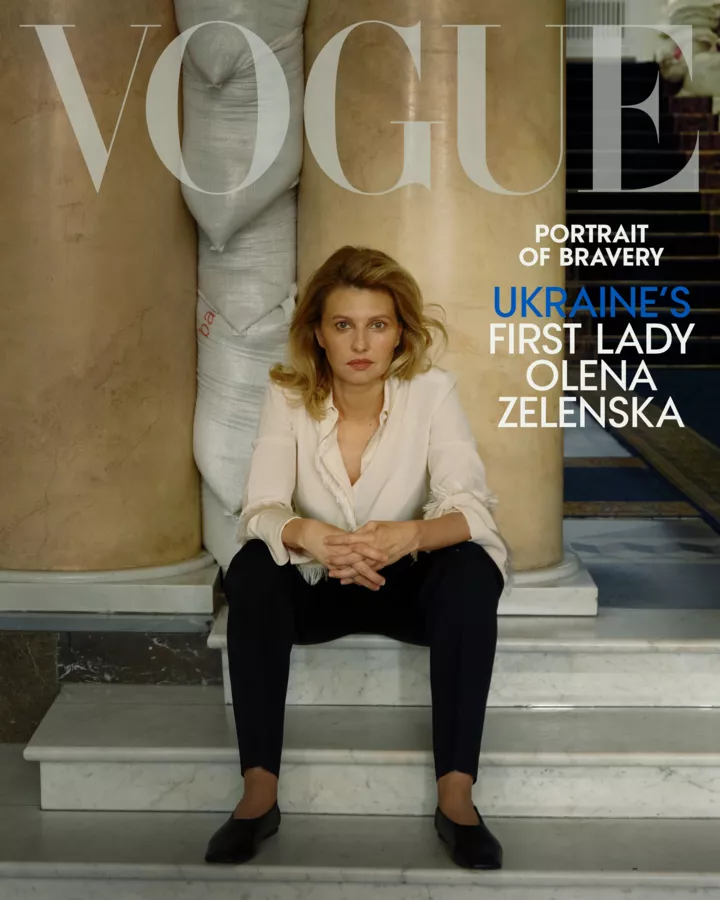
    Vogue cover with Olena Zelenska

    Gendered disinformation can appear not only in the media but in other forms of public life, also. In 2018, the NGO Dukhovnist submitted a draft decision to a Brovary City Council session, which voted to appeal to the Verkhovna Rada [Parliament of Ukraine], the National Security and Defense Council, and other state institutions to remove from legal acts in education and from textbooks the norms and principles of sex education aimed at “overcoming gender stereotypes.” The appeal also called for a ban on “propaganda of various types of deviant sexual behavior,” in particular in the form of “so-called ‘equality marches,’ ‘pride parades,’ ‘gay parades,’ ‘queer culture festivals,’” etc. The reason for the appeal and the decision was the sex education project of Daryna Mizina, a Gender in Detail journalist who also worked with the local Brovary city media. The city council session interpreted the project as “encouraging sexual experimentation” and “promoting masturbation and homosexuality.”[4] The local media editorial office started receiving complaints about Daryna.

    Gendered disinformation can target not only a certain woman, but also a group of women. russian (more often) and Ukrainian (less often) social media claim that since the beginning of the full-scale war, many Ukrainian women have moved abroad to engage in sex work, some brothels have opened with specifically Ukrainian women, this work is more desirable than other types of income, and Ukrainian women spread sexually transmitted diseases, but at the same time fill the state budget, which is not otherwise filled (“Zelensky sold Ukrainian women abroad”).[5]

    Manipulating gender issues and promoting inequality is a constant component of far-right propaganda, as the entire patriarchal ideology is often an integral part of the far-right one. Emancipatory movements, such as socialism, liberalism, feminism, and the movement for the emancipation of the LGBT+ community, have been and are considered hostile by various versions of far-right and hatemongering ideologies. The strengthening of rape culture is a consequence of the spread of such ideologies, and gendered disinformation is their tool.

    Far-right movements, patriarchy, male supremacy

    The Third Reich considered family to be a genuine “cell” of the state. Ludwig Leonhardt, an expert in racial theory, argued that the family is a biological inheritance, and biological inheritance is the reproduction of the race. He authored “Marriage and Racial Hygiene,” which was promoted as a guide for proper marriage.

    Another race theorist, Hermann Paul, believed that “free love” was detrimental to racial health. In general, the gender division in the culture of this era was extremely strong: the man held responsibility for all public affairs, and the woman, as the “keeper” of the family, was responsible for housework, raising children, and serving her husband’s needs.

    The Nazis also defined standards for a woman’s body in reproductive and physiological terms: they discouraged decorative cosmetics, required women to conform to the standards of the Aryan race, and encouraged physical education and hygiene as a guarantee of reproducing a healthy race. Modern dances (jazz, etc.) were banned as encouraging women to become promiscuous.[6]

    The famous far-right theorist of the first half of the 20th century, Julius Evola, considered men and women’s physical dimorphism to be a reflection of spiritual dimorphism. In his view, men and women had their own separate paths in life, and deviation from them was “a conflicting and unnatural way of being.” Manhood could be of two types: a warrior and an ascetic. Womanhood also had two types: a lover and a mother, and both of these types existed as subordinate to men (husbands and sons, respectively). Self-expression in these areas required a woman to forsake everything masculine in her personality, and a man, respectively, to forsake everything feminine. Evola linked all this to ancient traditional cultures, though indirectly, not in the ordinary sense of what should be borrowed from the traditional cultures for modernity, but rather in the spiritual and symbolic sense.[7]

    Our contemporary, the known russian far-right political philosopher and propagandist Alexander Dugin, also did not miss an opportunity to comment on feminism. It is much more difficult to analyze him than previous thinkers, because his philosophy spans from an eclectic mix of very different ideas to a set of words that are only grammatically connected. Nevertheless, it can be deduced that he roots in the legend of the Great Mother, who was allegedly subdued by men, and now women are gaining strength again, and therefore humanity is facing such horrors as atheism, materialism, and progress.[8]

    This is a vivid example of gendered disinformation and an unscientific approach, the promotion of a mythological worldview. On another occasion, Dugin generalized “LGBT+, perverted feral feminism, transgender people, wokeism, cancel culture, and the entire culture of the modern West” as “systematic demonization of the civilizational scale” and an illustration that “counter-initiation powers” have gained access to authority in Western Europe and the United States.[9] One should not look for any other meaning in this than incitement of hatred towards the West and all the mentioned groups and phenomena among all who know that demons are bad.

    Another contemporary conservative thinker is the famous Canadian psychologist and bestselling author Jordan Peterson. In 2016, he participated in a local debate about transgender people on the conservative side, refusing to address people by their preferred pronouns. Peterson was manipulatively comparing transgender people and their allies to left-wing radicals, left-wing radicals to Nazis, and criticized Marxists and postmodernists as just along for the ride. As in Dugin’s case, there is no need to analyze this intellectual mess in detail, because its main purpose is to vent supremacists’ frustration, who feel the loss of male privilege and consider themselves to be affected by the emancipatory tendencies of society in general and by allegedly manipulative women in particular.

    According to Peterson himself, 80% of his YouTube audience are young men.[10]

    Jordan Peterson

    In recent years, U.S. commentators have begun to distinguish male supremacy as a separate social phenomenon. Male supremacists advocate rigid gender roles and protest against feminism. While “ordinary” far-right movements have patriarchal views internal to their ideology, male supremacists focus specifically on the gender aspect.

    The word “incel” (involuntary celibate) did not originate out of the male supremacist community, but it quickly spread there. The incel subculture’ worldview is based on the assumption that women choose attractive men and leave unattractive ones behind, which is expressed in a sharply misogynistic and coarse way. The subculture reduces the image of women to a lustful beneficiary who manipulates men for sex or money. Although this conventionally stereotypical woman has no interest in incels, they still consider themselves better than she is. In their ideology, there is a hierarchy among men, and women are basically below all levels of the male hierarchy.

    This worldview paradigm fits neatly into the rape culture because it assumes that women’s attractiveness and sexual activity globally belong to men and are simply “unfairly” distributed among them, i.e., not in the way incels would like. Since women are not rushing to line up for the bearers of the misogynistic worldview, thus prolonging their celibacy, the view works like a self-fulfilling prophecy. This worldview also belongs to the conservative spectrum, because, according to incels, “before” (i.e., before the onset of feminism), the distribution of sexual “benefits” that women “bestowed” upon men was “fairer.” The incel ideology portrays its supporters as the “injured” party.[11]

    There are no separate statistics on whether incels commit sexual crimes, but some hate crimes are associated with them, which links incels to the “ordinary” far right. In 2020, there was a terrorist attack in the German city of Hanau: the attacker killed nine people in several bars overnight, then returned home and shot his mother and himself. On his personal website, the 43-year-old terrorist published a manifesto in which, among other extreme racist statements, he said that he had never been intimate with a woman.[12] In the United States and Canada, people associated with the incel subculture have also committed several terrorist attacks that killed up to 50 people.

    How russia is spreading conservative and violent narratives

    The regime maintains the patriarchal attitudes of russian society at the level of both federal policy and local practices. A story in 2015 shocked russian feminists: in Chechnya, the head of the local police department forced a 17-year-old girl to marry him, even though he was three times her age and already had a wife. Ramzan Kadyrov himself attended the wedding, and the girl was led by his “right hand man” Magomed Daudov. Despite protests from feminists and the human rights community, the wedding took place, and nothing is known about the girl’s fate after. The Ombudsman for Children’s Rights verbally normalized this situation, in particular with the phrase “some women are wrinkled as early as 27,” which he later had to apologize for.[13] In Dagestan, such cruel misogynistic practices as female genital mutilation have spread in recent years, with more than a thousand girls undergoing this surgery every year.[14]
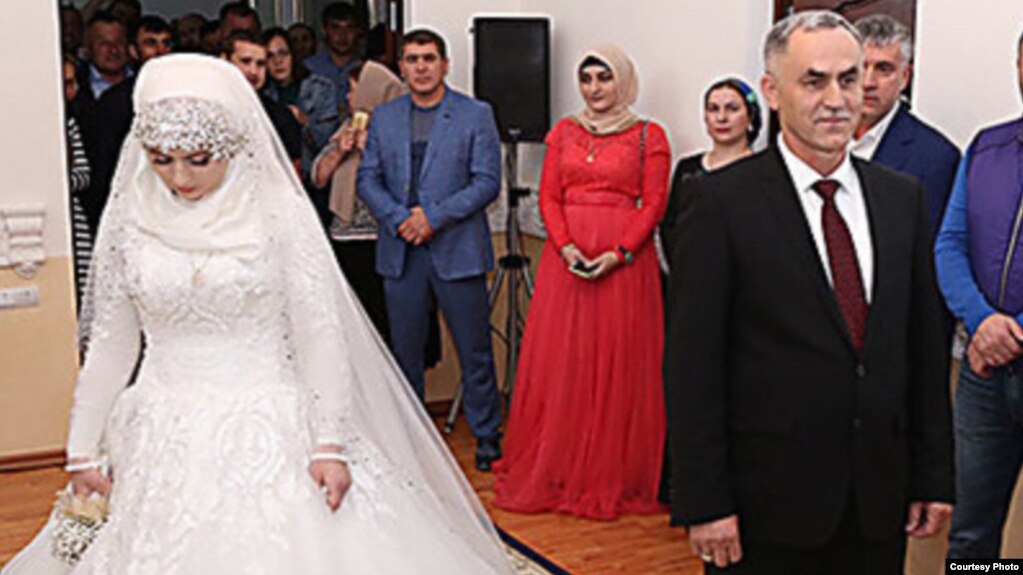
    Forced wedding in Chechnya

    In addition to reviving traditional patriarchal practices, there are new ones that are quite modern. The “male state” is a confirmed extremist movement, and it has been banned even in russia itself. This is a community of thousands of men, a vivid realization of rape culture, as it seeks to control women’s sexuality. These men publish photos of women without their consent to an audience of thousands, with mocking comments allegedly exposing “whores”, and private harassment, including threatening the women to send porn to their families. This movement is not only misogynistic, it also has a prominent racist focus: if a woman is suspected of having sex with a non-white man, and such suspicions are quite common for the movement, the extent of the abuse increases. For such women, they have coined a separate term: “inkwell.” The members of the “male state” call their ideology “national patriarchy.”[15]

    After the full-scale invasion of Ukraine, the level of everyday, domestic, and sexual violence increased in russia itself. However, the media and russian psychologists do not associate the war of aggression and the rape of Ukrainian women with patriarchy, instead attributing the increase in aggression to war-related PTSD, thus justifying the violence.[16] This means that the forces that should counteract rape culture are infected with it.

    russia’s patriarchal and conservative policies make it an attractive partner for far-right movements in other countries. Contrary to widespread perception, the Kremlin does not usually directly fund European far-right political parties. Rather, it is a win-win situation: for the world’s far-right, russia is a strong and influential country with a conservative regime. In turn, representatives of far-right forces act as “international experts” for domestic russian “consumption” and perform other useful roles, such as observers at illegitimate “referendums.” However, direct russian support can be found in the area of non-partisan cooperation, while media in different countries systematically pick up disinformation narratives favorable to russia.

    Conservative family policy is a significant part of what russia exports abroad through disinformation narratives.

    The World Congress of Families is a global network of organizations that oppose LGBT+ rights and abortion. It was founded in 1997 by American Christians and russians concerned about the demographic decline. It is believed to be funded by conservative russian oligarchs Konstantin Malofeev (who financed russia’s military intervention in Ukraine and is under numerous international sanctions) and Vladimir Yakunin.[17] In reality, the Congress operates as a tool of russian soft power, not only promoting patriarchal views on family and gender issues, but also spreading pro-russian political narratives. For many years, dozens of politicians from all over Europe have participated in WCF events, and in general, over 700 people from more than 50 countries have joined this network over the past 15 years.[18]

    According to the former French representative of the WCF, Fabrice Sorlen, “this Europe of people and nations will replace a technocratic Europe with a more traditional European civilization; it will promote Christianity in a Europe hitherto dominated by the LGBT lobby. It must unite with Vladimir Putin’s russia to create a version of Europe that stretches from the Atlantic to the Pacific.”[19]

    Conservative tendencies are spreading from russia to neighboring friendly countries. In Georgia, Levan Vasadze, a major real estate investor and former board member of a number of large companies in russia, known for his anti-immigrant, anti-liberal, and ultra-religious views, founded the Demographic Revival of Georgia Foundation, which is part of the WCF. In May 2021, Vasadze announced his official entry into politics as the founder of the “Unity, Essence, Hope” social movement. In the same year, he called on the government to cancel Tbilisi Pride, which was actually right-wing radicals violently interrupted.[20] A Moldovan President himself, Igor Dodon, patronized the 2018 WCF Congress in Chisinau.[21]
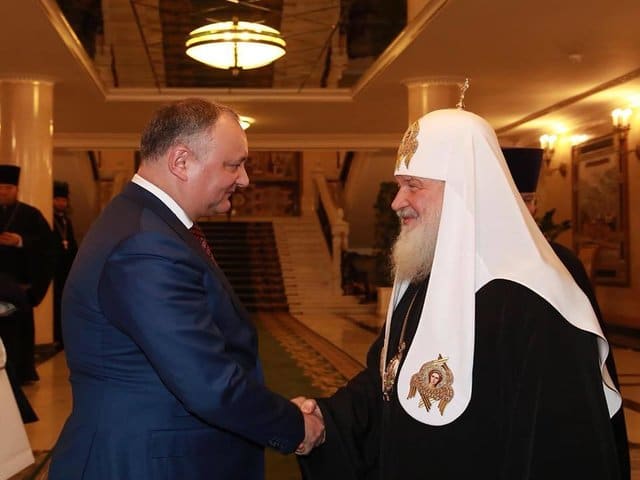
    Moldovan President Igor Dodon meets with russian Patriarch Kirill

    russian gendered disinformation in Ukraine

    Research by the Ukrainian Women’s Fund shows that in Ukraine, the conservative part of society could also have received support from the russian Federation, and gendered disinformation was the channel of that support. Narratives benefitting russia were broadcast through affiliated structures (in particular, the Ukrainian Orthodox Church of the Moscow Patriarchate), the media, and other religious and conservative organizations and initiatives.

    The researchers imply that in 2013, russia conducted a strategic information operation to prevent Ukraine’s European integration, which was supported by a tactical information operation to prevent the adoption of draft law No. 2342 (On Amendments to Certain Legislative Acts of Ukraine on Preventing and Combating Discrimination in Ukraine) and further expansion of the scope of the law “On Principles of Preventing and Combating Discrimination in Ukraine.” In the russian and Ukrainian media, similar narratives were observed. They were manipulating the concepts of “sexual orientation,” “non-traditional orientation,” “European values,” and “gender” as those that disrupt the family institution in Ukraine. There was also an attempt to form opinion with draft law No. 2342 and further expansion of the scope of the law “On Principles of Preventing and Combating Discrimination in Ukraine” as a step towards the dominance of fascist ideology in Ukraine (which is obviously not a fight against real fascism, but the use of an emotionally charged term to incite hatred).[22]

    russian narratives in Ukraine did not stop after 2014. For example, in September-October 2015, Vitaly Milonov, a member of the St. Petersburg Legislative Assembly, unleashed a wave of discrimination against the LGBT+ community in the russian media. Simultaneously, narratives similar to Milonov’s (family values are the same as Christian values, the state must protect the family from the LGBT+ community, Ukraine – or russia for Milonov – stands strong in preserving traditional family values, etc.) spread in Ukraine with the common message “joining the EU will lead to the destruction of the family.”[23]

    In 2021, a delegation of the Polish traditionalists Ordo Iuris visited the Verkhovna Rada Committee on Foreign Policy and Interparliamentary Cooperation aiming to convince them against ratifying the Istanbul Convention. Polish feminist activist Clementine Sukhanov conducted her own investigation and provided supporting documents that Ordo Iuris is indirectly funded by russian oligarch Konstantin Malofeev.[24] In Ukraine, the organization signed a memorandum of cooperation with Ruslan Kukharchuk’s conservative association All Together. [25] Kukharchuk’s other organization, Love Against Homosexuality, had been distributing leaflets as early as 2017 with not only conservative disinformation (the rights of LGBT+ people allegedly contradict human rights), but also with images of St. George’s ribbons on them (the ribbon is a russian military symbol). The organization Katechon took part in the same action. They borrowed the rare Greek word, which has no family or heterosexual connotations, from the think tank of the same name. This think tank is a joint project of the aforementioned Malofeev and Dugin.[26]
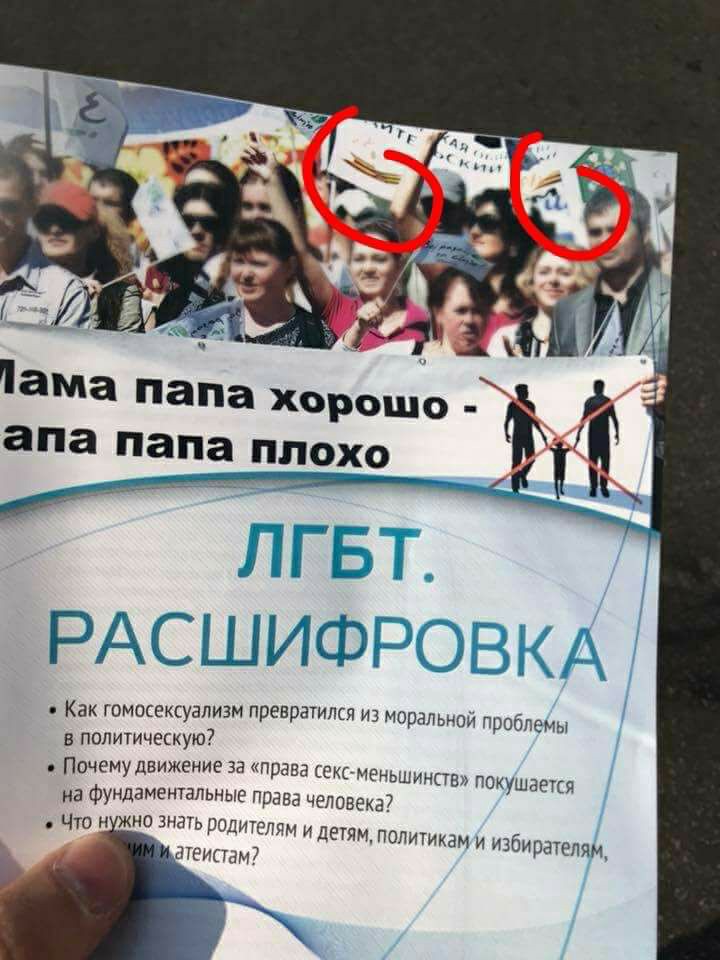
    Leaflet of the organization “Love Against Homosexuality”

    A news report about Ordo Iuris’ visit to Ukraine also bore signs of disinformation. It presented Ordo Iuris as “an independent legal organization based in Poland, accredited by the European Parliament… aiming to promote legal culture based on respect for human dignity and rights.”[27] In reality, it is a Polish branch of the international pseudo-Catholic movement Tradition, Family, Property (Tradição, Família e Propriedade), founded in Brazil in 1960, which allegedly promotes the “Catholic crusade.” In fact, it is not subject to the Vatican and has a history of extremism in Latin American countries (in particular, its members allegedly plotted to assassinate the Pope during his visit to Venezuela in 1984, after which the movement was banned in the country). In France, the TFP movement is considered a destructive cult (raising funds for unspecified purposes, obscure hierarchy and structure, and progressing requirements for members). The Canadian Bureau of Immigration and Refugees also lists TFP as a “religious paramilitary group.” The Vatican does not recognize this movement and is conducting an internal investigation into it (in particular, for using exorcism and rumors that all recent popes are controlled by the devil).[28]

    Conclusion

    To summarize, gendered disinformation is a practical tool for spreading rape culture and normalizing violent attitudes towards women and violence as such. Gendered disinformation can be disguised as “conservatism” or “family values,” but it does not lose its cannibalistic nature. russia was and is using gendered disinformation in various forms as part of its imperial propaganda, in particular by clogging the Ukrainian information space and supporting conservative movements and activists in our country and other countries.

    After the russian federation’s full-scale invasion, Ukraine finally ratified the Istanbul Convention, and the prevalence of conservative narratives in the media and public space decreased. This can be explained by the fact that conservative activists have more important things to do and security services are working more effectively.

    Photos: Annie Leibovitz for Vogue, Rene Johnston / Toronto Star / Getty Images, Radio Svoboda, Facebook page of Ihor Dodon, Zorian Kis


  • The Culture of Consent in Ukraine: Who Shapes It and Why It Matters

    The Culture of Consent in Ukraine: Who Shapes It and Why It Matters

    A few years ago, social media was full of loud jokes and irony about amendments to Ukraine’s Criminal Code that strengthened accountability for sexual and domestic violence. One of the main targets of ridicule was the clause on consent to sexual contact. Now, four years after those legal changes, the idea of a culture of consent has become much clearer and more widely understood.

    Read more about these changes in the article by Kateryna Viter.

    The reasons behind this social shift include active youth education, more accurate and sensitive media coverage, and the advocacy of laws protecting against sexual violence. In other words, building a culture of consent in Ukraine is a daily effort shared by people across different fields — blogging, journalism, politics, advocacy, psychology, and non-formal education.

    Gender in Detail spoke with active women from these sectors to learn how they are helping transform the so-called “rape culture” into a culture of consent, and why doing so is especially important right now.

    Read more about the difference between a culture of consent and a culture of rape in the article by Yevheniia Dyshleva.

    Psychology

    “Previously, no one spoke about the culture of consent — society assumed women should be submissive.”

    Teaching conscious consent, addressing stereotypes, promoting nonviolent communication, and supporting children and teenagers in schools and universities — this is only part of how psychologists influence personal development and the formation of personal boundaries.

    According to Maryna Didenko, PhD in Psychology and expert in tolerance and nondiscrimination, the culture of consent in a psychological context is a set of beliefs or behavioral habits that a person uses to interact with others, including their partner. These habits are shaped by attitudes, upbringing, and learned behavior.

    “Previously, no one spoke about the culture of consent, so society mostly believed that women should be obedient. There were stereotypes that sex is essential for men but not for women. Such ideas harm both sides — women are pressured not to refuse sex, and men are pressured to always want it,” Didenko explains.

    The formation of a culture of consent in adulthood happens through self-awareness, personal development, psychotherapy, and education. These processes help people reshape the basic beliefs that drive behavior.

    The psychologist also notes that during the full-scale war, many couples are separated and cannot engage sexually in person. However, she sees this as an opportunity to build consent culture through communication — by discussing uncomfortable topics, including sex.

    “From a distance, partners can talk about their values, desires, and fantasies. This helps them maintain intimacy and lays the foundation for healthy interaction in the future,” she says.

    At the same time, war brings heightened aggression. Unprocessed emotions, alcohol or drug use, and other stressors heavily affect human interaction, including in sexual contexts. The number of domestic and sexual violence cases has already increased. Didenko believes that zero tolerance and social condemnation will gradually influence all social groups and lead to real change.

    Blogosphere

    “If people start googling what ‘active consent’ or ‘active non-consent’ means — I feel an inner victory.”

    TikTok and Instagram bloggers play a significant role in forming Ukraine’s culture of consent. They address gender stereotypes, sexual and domestic violence, discrimination, and related topics — reaching teenagers and young adults, the main audiences of these platforms.

    Many bloggers use their platforms for educational outreach, explaining the importance of consent and mutual respect in relationships. Creators such as “U Trusakh” (@utrusakh), “Moe Dilo” (@moe_dilo), and bloggers Emma Antoniuk and Yana Brenzei from “Nam palae” (@nam_palae) regularly publish videos analyzing high-profile harassment cases, sharing statistics, and raising awareness.

    Ukrainian sex educator and blogger Asya Say (on Instagram and TikTok: @asyasay) believes that understanding active consent can save relationships — and even lives — because it reduces the risk of violence from the very beginning.

    “For our society, the culture of consent is still a kind of mysterious creature. Even though there’s been ongoing work on nonviolent communication, people still react with confusion when they hear about consent. But if they start googling what ‘active consent’ or ‘active non-consent’ means afterward, I feel an inner victory,” says Asya.

    She notes that some Ukrainians still view asking for consent as a sign of weakness, believing that questions like ‘Can I do this?’ or ‘Do you want this?’ kill romance.

    “But more people are beginning to realize that this is about their own safety. In my experience, people under 30 are more receptive to the idea of consent. It’s harder with older generations, especially those deeply rooted in patriarchal or so-called ‘traditional family values,’” she adds.

    Asya emphasizes that children should start learning about sexual consent around the ages of 9–10, since the average age of sexual initiation in Ukraine is 15 — even though, under Ukrainian law, teenagers that age cannot legally give consent to sexual activity.

    According to Asya, it is also crucial to promote the culture of consent in mass culture — in films, TV series, and books. That way, it will no longer be seen as “a new idea imported from the West” but will instead become an unquestioned social norm.

    Politics

    “Work with civil society should start with conversations with children.”

    Another major driver in shaping the culture of consent in Ukraine is legislation — or more precisely, the people who design, adopt, and implement it. Lawmakers determine how quickly new frameworks that strengthen protection for survivors of any kind of violence are introduced and how effectively perpetrators are held accountable.

    Among those advocating for legislation to combat domestic and sexual violence and to establish the concept of consent in law is MP Inna Sovsun and her team. In March 2023, Sovsun submitted a bill to the Verkhovna Rada that would allow criminal proceedings for sexual violence without a formal complaint from the victim. She also actively supported the ratification of the Istanbul Convention.

    Gender in Detail spoke with Maria Klius, a human rights advocate and assistant to MP Inna Sovsun, who writes legislative texts and anti-discrimination reviews for educational materials.

    “For ten years, everyone who worked on advocating the ratification of the Istanbul Convention talked to politicians about its importance. Over time, this idea became so ingrained that now, as we work on implementation, we no longer have to explain the basics — like why women need specific protection,” Maria said.

    As part of broader advocacy efforts, public awareness has also increased, since many of Sovsun’s initiatives are widely discussed — from anti-discriminatory school textbooks to registered civil partnerships.

    Maria emphasizes that while the ratification of the Istanbul Convention was a huge victory for Ukraine, the next step — implementation — is even more challenging. The Verkhovna Rada is now considering several bills amending the Code of Administrative Offenses and the Criminal Procedure Code to regulate investigations of sexual violence, plea agreements, and related issues.

    “Our team also works with the Ministry of Education, because we are still fighting problematic phrasing in ‘Health Basics’ textbooks. We receive complaints about victim-blaming and other harmful narratives that contradict the idea of a culture of consent. This is critical, because if we want to work with civil society, we must start by talking to children,” Maria explained.

    Maria and her colleagues aim to reform the expert review process for school textbooks to ensure it involves qualified professionals, since current reviewers often ignore problematic content — even when students themselves notice it.

    “Voluntary consent is mandatory in every case.”

    Thanks to their legal expertise and work in protecting survivors of violence, female lawyers and human rights defenders also contribute to dismantling rape culture. They consult victims, help file complaints with law enforcement, and represent women who have experienced violence in court — ensuring that perpetrators face justice.

    They also collaborate with NGOs and advocacy initiatives aimed at combating violence and harassment, conduct trainings and legal education programs, and lobby for improvements in gender-based violence legislation. One of the key organizations working in this field is the Ukrainian Women Lawyers Association “JurFem.”

    As Marta Pavlyshyn, a lawyer and program manager at JurFem: Education, explains, the conversation about consent is directly tied to the 2019 legal reforms. Previously, under Ukraine’s Criminal Code, rape was defined only in cases where there was resistance or the victim was in a helpless state. The Istanbul Convention, which Ukraine signed in 2011 and ratified 11 years later, introduced the notion of consent to sex as central. This change criminalized acts that previously were not considered rape — even though they were committed against the victim’s will through intimidation or coercion.

    The reforms also criminalized sexual violence within marriage, which had often been ignored due to the idea of “marital duty.” Today, the law makes it clear: it does not matter whether the individuals are married or not — voluntary consent is mandatory in every case.

    “Ratifying the Convention legally obliges Ukraine to implement and report on its provisions. In terms of consent, the legislative framework is already sufficient: we have criminalized sex without consent and established liability for it, as the Convention requires,” Marta stressed.

    According to her, the next step is to change investigation practices, since outdated methods from before 2019 are still common. Some investigators still focus on the presence of physical injuries or the so-called “virginity test.” However, the key issue should be whether the accused obtained voluntary consent from the victim.

    Read a detailed legal analysis of Ukrainian legislation from the perspective of the culture of consent by Kateryna Viter.

    For survivors of sexual violence and all forms of gender discrimination, the JurFem: Support hotline offers free and confidential legal assistance:
    📞 068 145-55-90 or 0 800 30 55 90.

    JurFem lawyers provide full legal support — from consultation to courtroom representation. In one current case, JurFem attorneys represent a 14-year-old girl from Zakarpattia, who was raped by three teenage boys.

    Media

    “The issue of sexual violence is about a violation of the law — and about how justice should work.”

    Media professionals play a crucial role in raising public awareness about sexual and domestic violence. Their work creates public pressure on the government and legislative bodies to adopt necessary laws and policy decisions. At the same time, it helps strengthen the culture of consent and build a safer environment for everyone in Ukraine.

    Through sensitive and accurate coverage of difficult topics and publication of high-quality materials on cases of violence, journalists help audiences form a proper understanding of such events, challenge gender stereotypes, and dismantle the victim-blaming narrative.

    However, the media’s handling of sexual violence remains controversial. In February 2023, StopCor editor-in-chief Maryna Titova contacted Dana Okomaniuk, founder of the platform goodjob, who had publicly shared her story of being raped as a student years earlier. Titova asked Dana for the rapist’s phone number to obtain “his side” of the story. When Dana criticized this request as unethical and insensitive, the journalist published an article defending her actions as adherence to “journalistic standards.”

    Read more about how Ukrainian media cover rape in a series of articles by Olha Bilousenko: “‘The neighbors said nothing bad about him’: how Ukrainian media write about rapists,” “Not a sensation but a crime: how to write about rape without causing harm,” and “Accusations and unsolicited advice: how Ukrainian media write about survivors of sexual violence.”

    Writers and human rights advocates such as Larysa Denysenko, Liza Kuzmenko (head of the NGO Women in Media), and Oksana Pavlenko, editor-in-chief of Divoche.media, analyze and explain how journalists should write about sexual violence responsibly.

    Another prominent voice is Tetiana Troshchynska, editor-in-chief and radio host at Hromadske Radio. She emphasizes that journalism plays an essential role in shaping a culture of consent — especially when not only niche but also mainstream media with mass audiences begin to address these topics.

    “Sometimes the audience doesn’t even understand what a media piece is about. That’s why outlets with strong editorial principles must not back down — even if readers or viewers react negatively, saying things like ‘this problem doesn’t exist’ or ‘are we supposed to sign consent forms before sex now?’ It’s important to keep explaining these issues and stay on course,” Tetiana said.

    For journalists who are just beginning to cover sexual violence, she advises not only to report incidents, but also to help advance justice and give survivors space to be heard and supported.

    “The topic of sexual violence is about breaking the law — and about how justice should function. But it’s also about a person who has survived, found inner strength, and moved forward. The media should not focus on the survivor’s age, weight, hair color, or clothing,” she emphasized.

    Journalists should also help survivors feel safe to report crimes to law enforcement and understand the importance of working with lawyers who can help them seek justice in the least traumatic way possible.

    Education

    “Agreeing to go somewhere or have a drink is not the same as consenting to sex.”

    Non-formal education is another powerful tool for cultivating respect, mutual understanding, and consent. Today, lectures, workshops, and seminars on communication, relationship boundaries, and consent are becoming increasingly popular in Ukraine. Such educational programs are offered by organizations like Teenergizer, TolerSpace, Divchata, Vpershe, and by educators such as Yuliia Yarmolenko, Kris Shapran, and Marianna Anoshchenko.

    Olha Kukula, sex education trainer and coordinator of the initiative Girls Create, stresses that the culture of consent must be formed from early childhood. The first thing a child should learn is that their body belongs to them, and no one has the right to touch it without permission. Children in kindergartens and other group settings should be taught the “underwear rule” and how to say “I don’t like this.” As teenagers, they need to understand that every form of interaction — a hug, a kiss, or a touch — requires consent.

    “We still live in a culture of rape rather than a culture of consent. You can see it in how people react to high-profile cases of sexual violence. Girls are often blamed for going to someone’s house or being drunk. But agreeing to go somewhere or have a drink does not equal consent to sex. This must be openly discussed with young people,” Olha emphasized.

    This summer, she worked as a tutor at sex education training sessions for school and university students. Participants discussed sexual violence (including harassment on public transport, catcalling, and street harassment) and the concept of consent. Some girls later shared personal stories of harassment or how adults had blamed victims in similar cases.

    Olha admits it’s hard to measure the success of such work — trainers often don’t know how deeply their lessons affect participants, especially young people. Still, she is convinced these sessions are crucial for teenagers, who need not only information but also support — since many already have negative experiences yet fear speaking up for fear of being blamed again for “improper behavior.”

    The development of a culture of consent requires active engagement from society, as well as support from education, media, organizations, and government. This culture helps build a fair and equal society and creates a safer environment for women and children, who are most often subjected to harassment and various forms of violence.

    Gender in Detail has compiled several useful resources to help you better understand the concept of the culture of consent:

    • Free online course “Sexual Education” on Prometheus.
      The course provides answers to the most common questions teenagers have about sex and debunks popular myths about sexual life.
    • TV series Sex Education (Netflix).
      The show explores topics such as gender identity, hypersexuality, masturbation, teenage sexuality, pregnancy, and the importance of contraception.
    • Book Doing It: Let’s Talk About Sex by Hannah Witton.
      This global youth bestseller discusses sensitive but essential topics — first relationships, virginity and sexual experience, the negative effects of pornography and sexting, and healthy perceptions of one’s body and sexuality.

  • Legal vs reputational responsibility: lessons from the “Temliak case”

    Legal vs reputational responsibility: lessons from the “Temliak case”

    On August 9, photographer Anastasiia Soloviova (Chornobai) publicly accused her ex-boyfriend, actor Kostiantyn Temliak, of years of domestic abuse and humiliation. She described numerous incidents of physical and psychological violence. According to her, Temliak hit her, pulled her by the hair, twisted her arms, pushed her, controlled her life, and forbade her from communicating with friends or wearing revealing clothes.

    Anastasiia shared photos showing bruises on her body, videos of the actor’s aggressive behavior, and screenshots of abusive messages as evidence. Following her statement, musician Moonmanita claimed that Temliak had sent her inappropriate messages when she was 15 years old. Temliak publicly admitted to using physical force against Soloviova during their relationship, though he has not commented on other allegations — including the alleged sexual correspondence with a minor.

    After lawyers from the Miller Law Firm became Anastasiia’s legal representatives, she was officially recognized as a victim in the criminal case. With the firm’s involvement, she underwent the initial investigative procedures. The legal team collected and submitted evidence to the police, indicating not only violence against Soloviova but also other possible cases of abuse against women, and even the alleged corruption of a minor.

    The situation resurfaced in the media just before the 2025 Golden Dzyga National Film Awards ceremony.

    Divided reactions within the film community

    The decision to present Temliak with an award sparked public outrage. Opinions in the film industry were sharply divided: some argued that the Ukrainian Film Academy should have at least postponed honoring the actor until the investigation was completed, while others stressed that such a prestigious award should reflect not only artistic talent but also moral integrity.

    Actress and Academy member Olesia Zhurakivska joined the critics, sharply condemning the decision in a public post. She wrote that those responsible for awarding Temliak were “mocking victims and undermining the foundations of a civilized society.” Zhurakivska reminded readers that similar cases had occurred before — such as director Andrii Bilous, who was granted an academic title despite allegations of sexual harassment.

    Temliak’s decision to return the award

    Temliak ultimately responded to public demands by voluntarily returning his award the day after the ceremony. In his official statement, the actor said he was giving up the prize because the situation around his name required personal and legal resolution. He considered it inappropriate to keep an award that symbolizes public recognition amid such controversy and expressed a desire to focus on his work and cooperate honestly with investigators.

    “Returning the award is, for me, a sign of respect for the film community, the audience, and the award itself,” Temliak explained.

    The statement was generally welcomed online — many commentators noted that the actor had shown greater accountability than the award organizers, who had failed this reputational test.

    Ukrainian Film Academy’s response

    Following the backlash, the Ukrainian Film Academy announced plans to review its award regulations. Executive Director Hanna Machukh explained that at the time of the voting and award ceremony, there were no mechanisms to revoke a prize once it had been granted. The Academy has now begun polling its members about the possibility of annulling Temliak’s award and intends to amend its regulations next year to allow such reviews in similar situations.

    The Academy also clarified that the voting for Temliak’s nomination took place before the public accusations and criminal proceedings were initiated and that Temliak himself is not a member of the Academy. At the same time, it pledged to communicate its stance and actions more transparently in future cases of this nature.

    First of all, there was more than enough time.

    From August 9 — when the first evidence of abuse was made public — to the September 13 awards ceremony, 35 days passed. That’s more than a month — ample time for the Academy’s board or general assembly to convene and make a decision: at the very least, to suspend or revoke the award. For comparison, Hollywood institutions have taken decisive action within days.

    After the allegations against Harvey Weinstein, both the Academy of Motion Picture Arts and Sciences and BAFTA expelled him within a week. Netflix and the International Academy of Television Arts & Sciences ended their cooperation with Kevin Spacey within days of the accusations. BAFTA revoked Noel Clarke’s award immediately after The Guardian’s investigation was published.
    In all these cases, the decisions were swift and principled — no court rulings, no bureaucratic excuses.


    Secondly, the Academy is a private organizationч

    The Ukrainian Film Academy is registered as a non-governmental organization (NGO). By law, NGOs are private associations created by individuals, not the state. They are not government bodies, and thus not bound by the principle “only what is explicitly allowed by law is permitted.”
    In private law, the reverse applies: “everything that is not forbidden is allowed.”
    This means that even without a special procedure in its bylaws, the Academy had every right to act — to make a reputational decision based on ethics and values.

    All statements like “we don’t have such a mechanism in the regulations” or “changes will come next year” are manipulations. No law prevented the Academy from convening urgently and making an extraordinary decision. Western institutions have done so repeatedly — cancelling awards, cutting ties, or expelling members without pre-defined “procedures” — simply because the situation demanded it.

    Thirdly, the Academy demonstrated reputational impotence

    Instead of taking responsibility, the Academy hid behind talk of legal formalities, the absence of a court verdict, and promises of “discussion” and “future reform.” That is not defending values — it is abandoning them.

    Reputational responsibility is independent from legal responsibility. It’s not about punishment through law, but about public trust. When the prestige of the country’s main film award is at stake, taking a principled stance should have been unconditional. Otherwise, the award’s credibility — and the Academy’s — collapses.

    The proper course of action was clear

    1. Emergency board meeting or general assembly.
    2. A public statement: the award is suspended or revoked.
    3. Protecting institutional integrity and expressing solidarity with survivors of violence.

    This is standard global practice, and precisely what Ukrainian society expected. Instead, the Academy chose bureaucratic inaction — and lost the chance to prove that values, not formalities, guide the film community.

    The Temliak case exposed a fundamental misunderstanding: the difference between legal and reputational responsibility.

    Legal responsibility operates within the legal system — it begins only when guilt is proven in court or confirmed by official authorities. It requires evidence, due process, and adherence to the presumption of innocence. This is a lengthy process involving investigation, trial, and a final verdict. Only then does the state impose punishment — such as imprisonment or fines.

    Reputational responsibility, however, is entirely different. It’s not about courts or police — it’s about the community’s response to unethical or harmful behavior. It comes into play when a person faces professional and social consequences — loss of trust, career setbacks, or exclusion — even without a court ruling. It’s a “social sanction” imposed by peers and institutions that refuse to associate with someone whose behavior contradicts shared values.

    In the film industry, reputational consequences almost always precede legal ones. After multiple #MeToo allegations, studios and institutions routinely terminated contracts or rescinded awards — regardless of pending legal proceedings.

    The key point: reputational responsibility does not replace legal responsibility — but it also does not depend on it. One does not need to wait for a court ruling to make a morally right decision. When it comes to awards, public honors, or trust, organizations and peers have both the right and the duty to act on credible allegations.

    The presumption of innocence governs criminal law; in professional and creative communities, another principle applies — the presumption of a safe environment. The priority must be the well-being and dignity of the community’s members — especially in creative settings built on trust and mutual respect.

    In the global film industry, swift reaction to misconduct has become the norm — especially since the #MeToo movement. According to Axios, since 2017, hundreds of influential men have faced allegations of sexual harassment or violence; at least 201 lost their jobs or high-ranking positions, while only a handful faced formal convictions.

    Some of the most well-known examples:

    • Harvey Weinstein (USA): In 2017, after dozens of women accused the producer of sexual assault and harassment, he was immediately dismissed from his own company, and the Academy of Motion Picture Arts and Sciences unanimously expelled him. At the time, no charges had yet been filed — but the film community refused to wait.
    • Kevin Spacey (USA): After several men accused him of sexual misconduct in October 2017, Netflix halted all projects involving him, removed House of Cards from production, and reshot entire scenes of All the Money in the World with another actor. No court decision was needed — reputational risk alone justified the action.
    • Brett Ratner (USA): When six women accused the director of harassment in November 2017, Warner Bros. immediately terminated its partnership and cancelled upcoming projects. Although there were no convictions, Ratner has effectively been barred from the industry ever since.

    These examples show that reputation carries real accountability — and that institutions maintaining public trust cannot afford to remain silent.

    Global experience shows that reputational mechanisms are a way for society to self-regulate, especially where formal law acts too slowly or fails to respond effectively. When an industry takes responsibility to remove individuals whose behavior violates basic norms, it thereby:

    • Protects potential victims. Reputational sanctions help prevent further abuse. For example, suspending a teacher accused of misconduct immediately after the first complaint can protect students even during an ongoing investigation. In Temliak’s case, his former partner admitted she had remained silent for years out of fear and shame. A system of reputational accountability creates an environment where survivors see the community’s response and feel supported — it becomes easier to speak up, knowing they will be heard and protected.
    • Upholds declared values. If organizations publicly claim that “violence has no place in the industry,” the logical step is to avoid supporting those accused of violent behavior. Otherwise, words and actions lose alignment.
    • Safeguards the reputation of the community and the award itself. The prestige of an award like the Golden Dzyga — or any other — declines if it is given to someone with a questionable moral reputation. Such recognition should represent not only artistic excellence but also integrity. Reputational oversight protects the credibility of the brand and the audience’s trust: ignoring a scandal can undermine the legitimacy of the entire award.
    • Drives social change. When a well-known actor or producer faces reputational consequences, it sends a clear message: such behavior is unacceptable, and consequences are inevitable. This acts as a prevention for potential offenders and as validation for survivors. The success of the #MeToo movement lies precisely in this — public exposure was followed by swift repercussions, gradually transforming cultural norms.

    In summary, the situation with Kostiantyn Temliak became a kind of test for the Ukrainian film community. Initially, this test was not passed properly — excuses prevailed over moral imperatives.

    The key lesson: “Innocent until proven guilty” does not mean worthy of awards or trust until proven guilty.
    Legal responsibility will take time and deliver a verdict, but reputational responsibility already defines a clear boundary: violence and abuse will find no justification within the creative community, and protecting its values should not require a court seal.

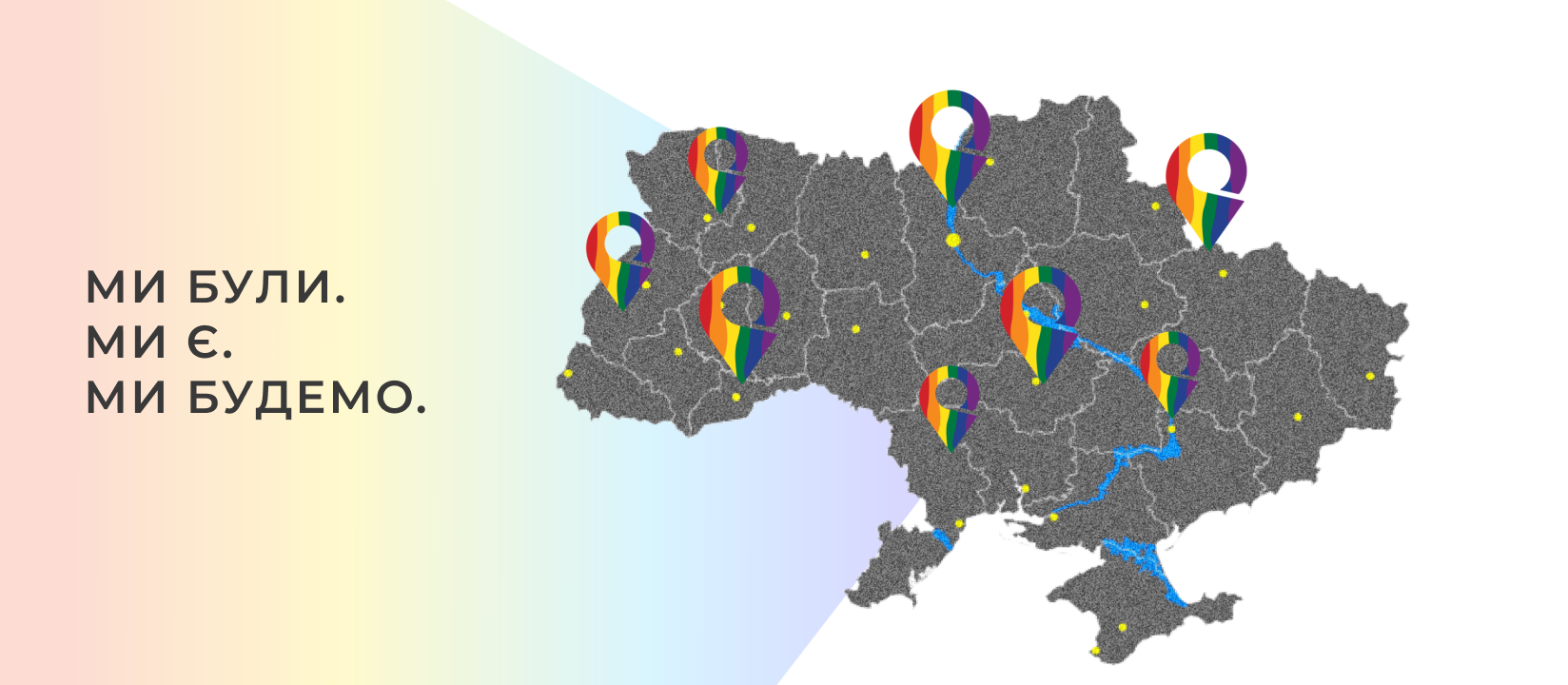
  • “We were. We are. We will be”: how Ukrainian businesses supported LGBT+ people during Pride Month

    “We were. We are. We will be”: how Ukrainian businesses supported LGBT+ people during Pride Month

    In June-July 2025, “Gender in Details” within the framework of the Human Rights Academy 2.0 by Gender Stream project, with the support of the Center for Disaster Philanthropy, implemented the project “We Were. We Are. We Will Be” – a campaign to support LGBT+ people and provide visibility to their achievements and daily challenges. We united a number of Ukrainian businesses around the idea of ​​​​end-to-end support. This was an attempt to show: Pride is not just a march or a one-time action, it is everyday life, and LGBT+ people exist, create, fight, love in this everyday life, without having basic rights like other people.

    Why this idea?
    The name and, accordingly, the slogan “We Were. We Are. We Will Be” became the basis of the campaign, because it speaks of continuity. LGBT+ people have always been a part of Ukrainian culture, history and art. They are also creating Ukrainian history today – on the front lines, in business, in volunteering, next to everyone. They will be in the future that we are building together.

    In times of war, when part of society is being pushed out or marginalized, it is important to remember: visibility and support are not luxuries, they are a matter of dignity and the right to life.

    How did businesses get involved?
    Several Ukrainian businesses joined the campaign — and it was more than just a partnership. At a time when open support for LGBT+ people in Ukraine still requires courage, each of these companies took an important step: they told their customers “you are not alone.”

    For example, together with the publishing house “Laboratory”, we talked about books that create space for research, including yourself. The publishing house “Laboratory” consistently supports the idea of ​​equal rights both in Ukrainian-language publications and in translations, so their selection of books has become extremely diverse. Among others, we can mention the cooperation with the project “Agents of Blood”, because “Blood is not about gender, blood is about life”, and together with them on Donor Day we will analyze stereotypes and prohibitions on donation for transgender people.

    All these posts, collections of information, and even laconic symbolic publications together became signs of safety and support for LGBT+ people who are looking for a space where they can breathe freely every day.


    This campaign became not just a few posts or collections – it became a symbolic sign of the times. “We were. We are. We will be” resonated with both those who belong to LGBT+ people and those who simply want to see Ukraine open and strong. People recognized familiar brands and logos, and this gave them a sense of security: if even a business dares to say it out loud, it means we are moving forward.

    On social networks, the campaign received many warm words – comments, messages, reactions. For some, it was the first reminder that Pride Month exists even during war. For some, it was an unexpected moment of support from a favorite company. For the businesses themselves, this was an important experience: to publicly declare solidarity, despite the risks and possible hateful comments.

    Such steps are not always measured by reach figures or thematic sales statistics. Their real result is in changing the atmosphere and attitude, in the feeling that LGBT+ people are visible and welcome in the public space. And this is the greatest value: the campaign opened the door to a conversation that seemed too risky yesterday.

    The conversation continues
    We created practical tools that remain after the campaign ends:

    A brand book with visual recommendations that helps businesses talk about Pride and LGBT+ support in a modern, stylish language, without clichés and banalities, and also allows companies to unite in joint communication. All our joint posts were prepared in this style. You can read the recommendations at the link.
    A text brandbook that provides ready-made step-by-step recommendations on how to write about LGBT+ people respectfully and correctly, avoiding stereotypes and offensive formulations, as well as demonstrating end-to-end support. This is not just a set of tips, but a kind of tone map that allows businesses to join the conversation confidently and without fear of making a mistake. You can read the recommendations at the link.
    A general map of friendly businesses in Ukraine, where those who have already openly declared today: “We are with you” are gathered. This map is more than a list of addresses of bookstores or other stores. It is a network of safe spaces that form a new geography of solidarity. You can view friendly businesses nearby at the link.
    Thus, “We were. We are. We will be” became a project that went beyond Pride Month. It gave people the feeling that change is possible, that even a few brave businesses can launch a public discussion. We are not stopping there: the brandbook, texts and map remain tools that will continue to work and are available for constant use in the coming years, because Pride is not a date on the calendar, but a value that we embody every day.

    The project “We were. We are. We will be” was created as part of the Human Rights Academy 2.0 project by Gender Stream with the support of the Center For Disaster Philanthropy. The content does not necessarily reflect the views of these organizations.

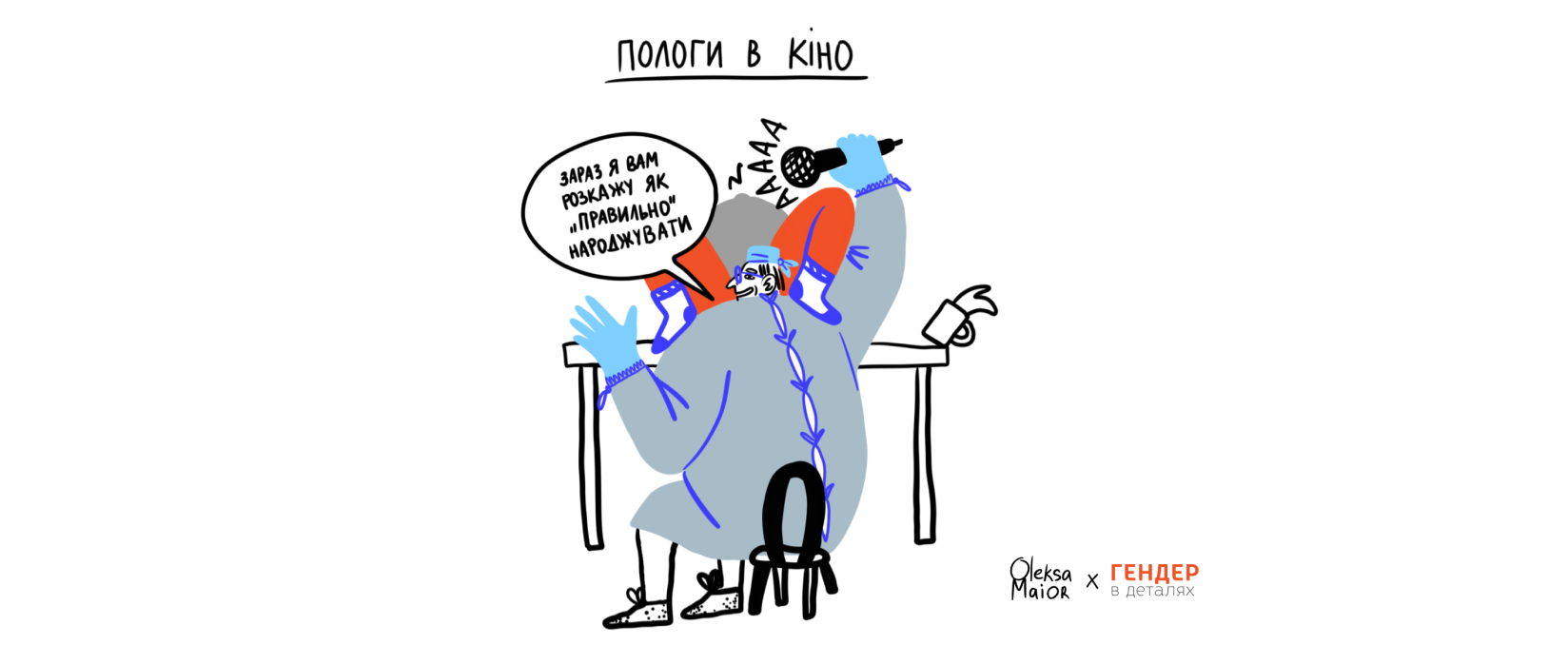
  • “My water has broken! Put me on the table immediately, I’m giving birth!”: What’s wrong with childbirth in popular culture

    “My water has broken! Put me on the table immediately, I’m giving birth!”: What’s wrong with childbirth in popular culture


    The breaking of the waters is the first sign that “it has begun.” This was the case with Rachel Green and Phoebe Buffay — the characters who formed the supporting structures of my teenage identity.

    But in reality, which is supposedly depicted in mass culture, the waters do break in the first stage of labor, which lasts (in primiparous women) up to eighteen hours. Oops! Sometime during this period it will happen. Or not. Or a week passes between the breaking of the waters and the delivery — this also happens, although not often. Just as infrequently as the epic breaking of the waters popular in the movies.

    For most women, labor begins with (drum roll) the realization that labor has begun. The woman feels contractions, and she needs to understand whether these are another training or “combat” contractions.

    And contractions don’t look epic in the movie: my friends, my pregnancy podcast listeners, and I, while going through contractions, walked in parks, picked up packages from the post office, or routinely conducted live broadcasts. And you know what we didn’t do? We didn’t grab our bellies, bending over sharply and shouting: “I’m giving birth! Help! Hurry up!” The beginning of labor is mostly boring.


    The influence of movies and TV shows on my expectations of my own childbirth was so strong that I knew for sure: ten minutes would pass between the start of contractions and “I see the head,” just like in the movies. Scientific information and the chorus of doctors didn’t sound as convincing as scenes from my favorite TV shows. Danielle from “Desperate Housewives” barely had time to get home from the house next door before she heard the cry of a newborn. Am I worse?

    After three hours of painless contractions, I banged on the door of the maternity ward as defiantly as if they were illegally holding the baby inside me. But the truth is that both the medical records and the statistics were true. Childbirth for most people is not only boring, but also long.

    Here’s a story about war-life balance and birth timing. My friends are preparing for a twin birth. She’s in Kyiv, and he’s in the Ukrainian Armed Forces 400 kilometers away. When she realizes that labor has begun, he has to come to the hospital immediately. This plan is realistic, because 400 kilometers is five hours of travel. Most first births don’t fit into this timing.

    This, of course, breaks a lot of scenarios. From the latest, “Train on December 31”, where a pregnant woman during an eight-hour journey from Kyiv to Lviv manages not only to spend time without any signs of labor activity, but also to give birth and rest after giving birth in a dining car.


    This is how childbirth is in the movie “Annette”.

    The “gold standard” of mass-culture childbirth is lying on her back and screaming. Some, like Rachel Green or the pregnant woman from the movie “Train on December 31”, lie down even during contractions and attempts. There is much more harm in this stereotype than it might seem at first glance.

    At least because this position is the most painful for a woman. And so, when you give birth, it can be more painful and less painful. To do this, you need to move and find what is best for you at each stage. This is not my opinion – this is the advice of modern medical protocols. And my practice.

    For millennia, women gave birth in positions that were most comfortable for them. This began to change in the 18th century, when births began to take place in hospitals, and male doctors gradually replaced traditional midwives. Women were not allowed to attend medical schools. It was believed that a man without a penis could not understand childbirth. Of course, where would he get one!

    Men declared themselves the main ones in matters of birth: medical interventions (such as the use of forceps) became a priority, and the natural course of childbirth was often ignored.

    A woman was transformed into an object from which doctors extracted a child. These are unexpected “achievements” that, among other things, were brought to us by the development of medicine. It was only in the 20th century that women began to receive medical education, and with it the right to subjectivity in their own childbirth.

    Modern medicine advises doctors to encourage women to move during labor. We could learn this from movies, but the male cult is still guided by the 18th century standard: a confused and frightened woman on her shoulder blades and a hero-savior who “gives birth” to her.

    That’s exactly what happened in “The Train on December 31,” where the woman in labor was placed on her shoulder blades on the table of a dining car. Imagine yourself on your back on a table in a dining car with your legs spread. Comfortable? Now add the movement of the train and the effort. Incredible, right?

    The only thing worse is that the woman is heroically saved by a man who calls three other men. Of course, no one asks women who have children about childbirth.

    Continuing the thought experiment, I will assume that childbirth on a train could go like this: the girl would stay in her compartment, a person would come there to help her, and the woman in labor would hardly climb onto the table if there was a bed.

    Why is it important to show the subjectivity of a woman during childbirth
    And not just intimidate with fear and pain, from which women are heroically saved.

    Let’s start from the opposite: for what purpose should we intimidate women? To show how a person instantly loses all control, hoping that someone will tell her how to save herself. For what? Fear is adrenaline, it slows down labor activity. Isn’t it better when a woman, crossing the threshold of the hospital, is not intimidated, does not expect horror, but has the opportunity to think: should/can I be comfortable during childbirth? How? Do I have the right to move, drink, eat (labor can last 20 hours, after all)? Whose needs during childbirth are the main ones – mine or the doctors’?

    The answer to the last question is key: if the main ones are the doctors (or those who take the birth), then I may have to obey them, even if they commit violence against me (shout, interfere with the birth without my conscious consent, press on my stomach, forbid me to move, determine the way in which the birth will take place against my will). This is all obstetric violence, a violation of the rights of the woman in labor, unacceptable behavior of medical personnel. And it is also important to know about this “beforehand”.

    I believe and know that the woman is the main one in childbirth, because, after all, she is the only person without whom the birth will not take place. Everyone else is present only to facilitate her experience, support, help. And save in those rare situations when it is really necessary.

    Such childbirth, by the way, is also shown in TV series.

    For example, This Is Us. Due to force majeure, the heroine Beth gives birth at home. She finds a comfortable position (miraculously, not on her back on the dining table, unlike Piper Halliwell, for example). And no one heroically saves her, she is supported by another woman and her husband.

    What to do. Consulting for the film industry and beyond
    Mascult must recognize its influence on the formation of women’s ideas about childbirth and stop exploiting emergency births and outdated practices. This will allow us to understand that the stereotypes about a helpless woman who needs rescuers-doctors only reinforce the culture of fear and increase the tolerance of obstetric violence.

    Screenwriters and directors should research the topic before writing and filming childbirth scenes. There are consultants in forensics, medicine, and martial arts in cinema, so why is childbirth still “drawn” from a TV series template? Take advice from midwives, doctors, doulas, watch documentaries about the medicalization of childbirth, and ask ChatGPT which stereotypes about childbirth are not true.

    Viewers also have a voice. We can share our own childbirth stories. It seems like a drop in the ocean, but each story can become a brick from which another woman can build her confidence. We can comment on and analyze childbirth scenes in films and TV series, ask why the heroine is screaming in pain and is not offered pain relief, why doctors act as if she has no voice. Demand creates supply.

    Mascult doesn’t just reproduce reality — it constructs it. So if we don’t want to see intimidated women ready for violence in maternity wards, then maybe we should show more than just the horrors of childbirth? Fear blocks childbirth. But it helps restore a sense of security, one’s own strength, and peace. Good words to describe childbirth, dear creators of mass content.

  • Feminism in Ukraine is always anti-colonial

    Feminism in Ukraine is always anti-colonial

    This article was first published on the website of the Heinrich Böll Stiftung.

    The colonial expansion of the Russian Empire and its direct successors – the Soviet Union and the Russian Federation – has long been widely ignored by Western intellectuals and politicians and almost completely excluded from critical analysis in the framework of postcolonial studies. This lack of political and academic will to properly address relations between the empire and the countries occupied and colonised by Moscow has created a blind spot right in the heart of Europe. Thus, from the Western perspective, the neo-colonial war started by the Russian Federation against Ukraine in 2014 mostly had to do with what Freud labels “the narcissism of minor differences”. After the full-scale invasion on 24 February 2022, Ukraine was predicted to fall within two weeks and Kyiv be taken in two or three days, according to official Russian propaganda lines, which used to frame Ukrainians as backward, less developed and passive objects of Russian imperial appetites. Those notions are embodied in the colonial ideology of russkii mir, or “Russian world”. Russkii mir is characterised by the idea of Russian national and cultural supremacy as well as the aggressive expansion of Russian “traditional” values that are heavily loaded with misogyny, homophobia as well as the state-sanctioned and supported fight against feminist values and achievements. Although anti-feminism as a well-founded and organised anti-democratic political project can be found in many societies around the globe, it constitutes a quintessential and integral part of the Russian imperialistic project. This essay aims to investigate the level to which anti-feminism is incorporated into the ideology of russkii mir and to show that Ukraine’s anti-colonial struggle includes opposition to the anti-feminist and anti-gender movements.

    Matryoshka – the perfect metaphor for russkii mir

    The perfect metaphor of what russkii mir truly is would be the Russian matryoshka – a set of dolls of decreasing size placed one inside of another, each with beautiful female faces painted on them. Bright and charming on the outside, on the inside they remind one of the medieval torture device known as the iron maiden, with its deadly spikes targeting those trapped in the matryoshka’s interior. The Soviet Union’s purportedly anti-capitalist and anti-colonial façade had effectively masked the darker reality of Russian colonial and genocidal practices towards indigenous populations residing within occupied territories. The deliberate concealment of this reality has obscured a history fraught with systematic racist mass killings, ethnic cleansing, and forced expulsions of Circassians throughout the century-long Russian colonial wars in the Caucasus from 1763 to 1864. Additionally, the tragic episodes of forced deportation and extermination of the Crimean Tatars in 1944 further exemplify the implementation of such policies. Ukraine was no exception and has suffered repeated Holodomors1 (human-made famine imposed to eliminate native Ukrainians and Kazakhs) and Rozstriliane vidrozhennia (political purges of the Ukrainian national elite in 1937–38), as well as complete and total Russification of Ukrainians in the attempt to turn them into mankurts,2 which would be compliant subjects for the Soviet regimeAll of these events were an integral part of the colonial presence in Ukraine. Overall, the Ukrainian language was banned 134 times (!) during 400 years of Russian occupation. The linguicide of the Ukrainian language has always been one of the most powerful and pervasive instruments of Russian colonial strategy aimed at diminishing Ukrainian identity. These practices were rooted in the understanding that the Ukrainian language has become a primarily distinguishing characteristic that highlighted national, historical and cultural differences between Ukrainians and Russians, who though sharing the same phenotype have stood on different sides of the colonial paradigm.

    «Ukrainian women activists advocating for women’s emancipation alongside national liberation.»

    To cover up these colonial practices, the Soviet regime invented the “friendship of peoples” myth, which denied any prejudice based on national or ethnic background within its borders. In its modern modified version, “the friendship of peoples” constitutes the foundation of another imperial construction of three “brother nations” – Russians, Ukrainians and Belarusians who together comprise a “Slavic Trinity”, the one “All-Russian” nation united under the rule of the predominant colonial ideology.

    Ukraine as “singing and dancing Little Russia”

    If the nation is an imagined community, as claimed by Benedict Anderson, the Ukrainian nation was re-imagined by Russian imperialism as an orientalised, exotic “singing and dancing Little Russia” – an ambivalent geopolitical construct in which “everything that is good […] comes from the common Russian legacy. Everything that is bad comes from evil, alien influences: Polish, Catholic, Jesuit, Uniate, or Tatar, Jewish, German, and so on”,3 but corruption was, of course, mainly a menace coming from the West. Such a paradigm has created a liminal space in which Russian colonialism could simultaneously claim “brotherhood” with “Little Russians”4 and label Ukrainians as “far-right nationalists and neo-Nazis”5 without causing any disruptions in the colonial logic.

    “The friendship of peoples”, although very prominent, was not the only imperial narrative used to whitewash the Soviet regime. Another one was a myth about women’s emancipation initiated and perpetuated by the Soviet government. Following the Russian Revolution of 1917, the Bolsheviks proclaimed women’s emancipation and abolishment of gender inequality, which was later anchored in in Article 122 of the 1936 Constitution of the Soviet Union.6 The Soviet state declared the creation of socialist modernity free of women’s oppression as one of its main and most progressive achievements. In reality, however, this decision was driven by the Soviets’ need to increase their labour force, which could be used to develop the growing economy of the communist state. In the framework of the formal gender equality proclaimed by the Soviet Union, domestic violence – just like sex itself7 – became an issue that was so marginalised and ignored by the state, it eventually ceased to exist in public discourse. In the meantime, women were not relieved from doing all the domestic work and taking care of children, and were thus being overburdened by “the second shift” – a load of domestic chores after their exhausting work in factories or collective farms. In addition to that, they were largely excluded from political decision-making, which had remained deeply rooted in patriarchal power hierarchies. Later, a few years before the collapse of the colonial monstrosity named the Soviet Union, Mikhail Gorbachev in his 1987 book Perestroika – New Thinking for Our Country and the World encapsulated the feminine mystique surrounding Soviet women with the idea that women should leave the public space and eventually “return to their purely womanly mission” (Gorbachev 1987, 117) – this idea still remains prevalent in Russian society today.

    Ukraine’s feminist movement is anti-colonial

    For the majority of Ukrainian women the Soviet dominance meant double colonisation of both their national and gender identities. The Ukrainian feminist movement was deeply rooted in the idea of national emancipation and independence – such a position being quite common for all countries experiencing colonial occupation of their territories (in the early 20th century Ukraine was occupied by the Russian Empire, the Austro-Hungarian Empire and Poland). Ukrainian women activists were active both in political and cultural spheres advocating for women’s emancipation alongside national liberation. When the Bolsheviks proclaimed the so-called emancipation of women, the names of those who were at the vanguard of the Ukrainian feminist movement were erased together with their decades of activism. Women were instead expected to be forever grateful to the Soviet regime for setting them free from the patriarchal yoke and prove their loyalty to the government through their hard work.

    Collapse of the Soviet Union and the need for “remasculinisation”

    The collapse of the USSR was not only “the greatest geopolitical disaster of the 20th century”, as Putin described it,8 but has also led to the decline of patriarchal masculinity, which was directly associated with the decline of Russian colonial hegemony, creating a need for “remasculinisation9 as a direct response to the fall of Soviet imperialism. The Russian Federation, as was its predecessor the Soviet Union, is a society built upon a patriarchal system of values in which “the legitimation of power often demands demonstration of the qualities of a “real man”.10 The “real man” in this case is defined not by what he is but rather by what he is not: he is not effeminate (and thus not homosexual), not non-white and not non-Orthodox.11 This societal demand was fulfilled by Putin who came to be prime minister and then president at the turn of the last century and who has become an embodiment of the new Russian neo-colonial masculinity “necessarily bound up with the enabling of violence – violence sufficient to overcome the considerable military capabilities of colonised societies” (Connell 2016, 306). Putin’s masculinity, with its visual imagery of the Russian Marlboro Man, its verbal aggressive domination of the political sphere and “a series of crude, macho aphorisms which have been collected as ‘Putinisms’” (Wood 2016, 2) has been used “to project the idea that he was capable of restoring Russia’s global stature” (Orlova 2018, 61). Soon Putin’s hypermasculinity as a scenario of power became central to the project of nation building and branding. In this project, gendered discourses have been widely used to create and perpetuate “the border between gendered Us and Others” (Voronova 2017, 219) – the discursive strategy that has proved to be especially successful since the Russian Federation’s first invasion of Ukraine in 2014. When the Kremlin launched a full-scale war against Ukraine on 24 February 2022, Putin stated:

    «The West is trying to destroy our traditional values [my emphasis] and impose its pseudo-values on us, which are supposed to consume us, our people, from the inside; all these ideas that it is already aggressively imposing in its own realm and that lead directly to decay and degeneration, because they contradict human nature.»

    What Putin did not mention in his speech is that these “traditional values” are heavily loaded with anti-feminist rhetoric and homophobia. Russian colonialism has recreated a Manichean world of the Cold War, one in which “traditional values” stand in opposition to “gender ideology”, a concept framed as an exclusively Western invention. Open anti-feminism has been an important part of the Russian political and social system for years. While the Russian Constitution continues the Soviet tradition of proclaiming gender equality de jure (Article 19), the de facto Russian popular culture persists in marginalising feminism as an abnormal and perverted ideology since “normal” women should prefer family and children over the struggle for rights and equality. Anti-feminist and anti-gender discourses perfectly match the anti-Western, anti-democratic and anti-human rights narratives so widespread among Russian society and generously exported to those territories physically or ideologically occupied by Russian neo-colonial politics.

    National innocence menaced by Western sexual perversion

    Quite symbolically, after Putin became president for the third time in 2012, the term “Gayropa” began to be used widely in Russia as a slur referring to European civilisation (as a part of a wider Western civilisation) as opposed to the ultraconservative Russian civilisation, in order to stress the decay and degradation of an LGBTQI+-friendly Europe compared to the “traditional values” of the Russian Federation. Such a framing has marked the beginning of the sexualisation of Russian politics, which uses sexual anxiety to create a myth of national innocence that is constantly menaced by Western “sexual perversion”. In other words, anti-gender and anti-feminist movements have become the Kremlin’s tool for establishing russkii mir as the Russian version of the “politics of eternity”,12 which has imagined Russian nation as a “virginal organism troubled only by the threat of foreign penetration” (Snyder 2018, 57), thus requiring it to be protected against external monstrosities. As pointed out by Leandra Bias, the “[p]ublic bashing of ‘gender ideology’ serves several purposes at once. It serves to justify authoritarianism and repression inside the country; it legitimises aggression as part of foreign policy; and, finally, it creates common terrain with right-wing movements”.

    «Contemporary Ukrainian women and LGBTQI+ individuals play a significant role in the military. They exemplify a shift towards progressive ideals.»

    If Russia sees the collective West as its ultimate enemy and directly opposes it, Ukraine is regarded as corrupted by the West and being under so-called “external control”, as it has been put by Russian state propaganda. Such a framing presents Ukraine as a perverted and effeminate entity juxtaposed to the Russian ultramasculine patriarchy. It can be traced back to the gas dispute of 2006, when a Russian television program described Ukraine as a Mammonish kept woman, a “flighty Ukrainian mistress”.13 The same colonial rhetoric was used against Ukraine just a few weeks before the full-scale invasion when Putin referenced an obscene song lyric to demonstrate his vision of the relations between Ukraine and Russia. His words “Like it, or dislike it, bear with it, my beauty” clearly refer to the lyrics of the song by the Soviet-era punk rock group Red Mold: “Sleeping beauty in a coffin, I crept up and fucked her. Like it, or dislike it, sleep my beauty”. These lines, which directly imply rape and necrophilia, are symptomatic of Russian internal national misogyny and explicitly anti-feminist narratives, both of which constitute an inseparable part of Russian neo-imperial discourses and politics.

    Gender or anti-gender: who is attacking democracy in Ukraine?

    The Russian colonial presence in Ukraine has left deep marks on the cultural, social and political fabric of its society. Even after Ukraine officially proclaimed its independence in 1991, the coloniality of power14 continued to shape the Ukrainian socio-political landscape in social and religious practices, identities, beliefs, representations and other aspects of everyday life. Although anti-feminism was a part of this power matrix, the anti-gender movement has become its core: gender roles, norms and relations mainly defined by woman’s submissiveness, passiveness and domesticity as well as by explicitly homophobic rhetoric were transmitted through Russian-supported media and TV channels in Ukraine and through the Ukrainian Orthodox Church of the Moscow Patriarchate, which largely dominated Ukrainian religious life. Symbolically enough, in his sermon on Forgiveness Friday (the last Friday before Lent), the head of the Russian Orthodox Church named gay prides in Ukraine as the reason for Russia’s invasion of the country,15 thus confirming once again the relation between anti-gender discourses prevailing in the spaces dominated by Russian neo-colonial ideology, an ideology that resulted in the unjustified and unprovoked full-scale military violence against Ukraine in 2022.

    Ukrainian feminists have played a crucial role in responding to and challenging anti-gender narratives in their society. They have been at the forefront of deconstructing these narratives by advocating for gender equality, promoting women’s rights, and working to dismantle harmful gender stereotypes and prejudices. The study “Gender or anti-gender: who is attacking democracy in Ukraine”,16 conducted by Ukrainian feminist and human rights organisations La-Strada Ukraine, Women in the Media and Ukrainian Women’s Fund in 2020, reaches the conclusion that the rise of anti-gender ideology was a part of Russia’s information war against Ukraine after the start of the invasion in 2014. The authors of the study analysed the development of Ukrainian social discourses as well as societal initiatives and changes between 2013 and 2020, and pointed out that anti-gender discriminatory rhetoric was presented under the Russian Federation’s typical narrative of “protecting family values”, which claimed they were being threatened by feminists and LGBTQI+ people. Such a consolidation of anti-gender and anti-feminist movements can be defined as a Russian counter-reaction to the Revolution of Dignity, which took place in Ukraine in 2014.

    A new Ukrainian femininity: emancipation as an anti-colonial struggle

    Among other socio-political transformations, the Revolution of Dignity has produced a new kind of Ukrainian femininity – an active female agent who managed to find her place in the male militarism of the protests (Phillips 2014; Martsenyuk 2014). Starting from this period, the coloniality of gender17 in Ukraine started to be challenged by the process of what Ukrainian philosopher Tamara Zlobina has called “gender decay”18 – the rejection of old gender models and the conception of a new emancipatory social rhetoric, which has allowed high social mobility and visibility of women in spheres traditionally associated with men: politics, military services, business and volunteering. Moreover, the role of women in nation- and state-building processes was officially recognised at the highest level and secured by the law: in 2015, the Verkhovna Rada (Ukraine’s parliament) adopted the “Law on Amending Certain Legislative Acts of Ukraine”, which was formulated to prevent discrimination in the labour market based on gender, gender identity or sexual orientation, and in 2017, the Ukrainian Health Ministry abolished a decree dating back to Soviet times that prohibited women from being employed in 450 professions considered dangerous to women’s reproductive health. Another significant change was Decree No. 292,19 issued by the Ukrainian Defence Ministry in June 2016, which opened up staff positions for privates, sergeants and sergeant-majors to women undergoing military service under contract. The importance of this decree can hardly be overestimated. Before 2016, women who took part in military operations as snipers or gunners were formally registered as cooks, nurses or other non-combat positions, thus limiting their career advancement in the military as well as denying them social benefits that their male peers enjoyed at the time. As of November 2022, there are almost 60,000 women serving in the Ukrainian Armed Forces, with approximately 19,000 holding civilian positions and approximately 41,000 serving in a military capacity. Some 5,000 of the latter group are directly engaged in combat operations.20

    While the Russian Federation officially decriminalised domestic violence in February 2017 and passed a law banning “LGBT propaganda” among adults in November 2022 (which followed the 2013 “gay propaganda” law that prohibited the dissemination of information about “non-traditional” sexual relationships to minors and that was misused to suppress LGBTQI+ rights and activism), Ukraine’s parliament has ratified the Istanbul Convention and unanimously passed a bill banning hate speech in the media against LGBTQI+ people. These two changes to Ukraine’s legislation were adopted after Russia’s full-scale invasion of Ukraine (in July 2022 and December 2022 respectively) and demonstrate that Ukraine has chosen to build a democratic and just society based on human rights and the rule of law.

    Instead of conclusions

    The logic of Russian neo-colonialism turns the Cartesian ego cogito, ergo sum (I think, therefore I am) into the imperial ego conquiro, ergo sum (I conquer, therefore I am).21 This assertion involves not only the colonisation of territories, but also the colonisation of minds and identities. Anti-feminism and anti-gender discourses constitute a central pillar of the ideology of russkii mir and have proved to be an efficient tool of Russian colonial expansion. Conveniently framing gender equality, feminism and women’s rights as well as the support of LGBTQI+ people as a cunning strategy employed by the collective West to destroy the Russian nation, the Kremlin sweeps away democracy, human rights and the rule of law in order to establish its rule based on the “traditional values” of misogyny and homophobia. Ukrainians are today persistently striving to uphold their national identity and advance gender emancipation, drawing parallels with the women’s movement in Ukraine a century ago. Contemporary Ukrainian women and LGBTQI+ individuals play a significant role in the military, combating the influence of a conservative ruskii mir and thus exemplifying a shift towards inclusivity and progressive ideals.

    If we really want to defeat neo-colonial forms of oppression and violence, it is important to confront anti-gender movements and support women’s rights and gender equality worldwide, since without them true democracy, peace, security and stability cannot be achieved. Let us never forget that.

    —–

    Bibliography

    Bias, Leandra (2023), “The International of Antifeminists”, available at: https://blogs.lse.ac.uk/gender/2023/02/24/4808/.

    Connell, Raewyn (2016), “Masculinities in global perspective: Hegemony, contestation, and changing structures of power”, Theory and Society, 45: 303–318, available at: https://www.jstor.org/stable/44981834.

    Freud, Sigmund (1930), Civilisation and Its Discontents (London: Hogarth Press).

    Gorbachev, Mikhail (1987), Perestroika – New Thinking for Our Country and the World (Toronto: Fitzhenry & Whiteside Ltd).

    Martsenyuk, Tamara (2014), Гендерна соціологія Майдану: роль жінок в протестах. Постсоціалістичні суспільства: різноманіття соціальних змін: матеріали Міжнар. соціологічних читань пам’яті Н.В. Паніної та Т.І. Заславської, available at: http://ekmair.ukma.edu.ua/handle/123456789/3511.

    Orlova, Alexandra (2018), “Russian Politics of Masculinity and the Decay of Feminism: The Role of Dissent in Creating New ‘Local Norms’”, William and Mary Journal of Race, Gender, and Social Justice, 25/1: 59–86, available at: https://scholarship.law.wm.edu/wmjowl/vol25/iss1/4.

    Phillips, Sarah D. (2014). “The Women’s Squad in Ukraine’s Protests: Feminism, Nationalism, and Militarism on the Maidan”, American Ethnologist, 41/3: 414–426, available at: https://www.jstor.org/stable/24027362.

    Restrepo, Eduardo (2018), “Coloniality of Power”, in Hillary Callan (ed.), The International Encyclopedia of Anthropology (New York: John Wiley & Sons, Ltd), available at: http://www.ram-wan.net/restrepo/documentos/coloniality.pdf.

    Riabov, Oleg and Riabova, Tatiana (2014), “The Remasculinization of Russia? Gender, Nationalism, and the Legitimation of Power Under Vladimir Putin”, Problems of Post-Communism, 61/2: 23–35, available at: http://dx.doi.org/10.2753/PPC1075-8216610202.

    Riabczuk, Mykola (2010), “The Ukrainian ‘Friday’ and the Russian ‘Robinson’: the Uneasy Advent of Postcoloniality”, Canadian–American Slavic Studies, 44: 7–24, available at: https://brill.com/view/journals/css/44/1-2/article-p7_2.xml.

    Snyder, Timothy (2018), The Road to Unfreedom: Russia, Europe, America (New York: Crown).

    Voronova, Liudmila (2017), “Gender politics of the ‘war of narratives’: Russian TV-news in the times of conflict in Ukraine”, Catalan Journal of Communication & Cultural Studies, 9/2: 217–235, available at: https://doi.org/10.1386/cjcs.9.2.217_1.

    Wood, Elizabeth A. (2016), “Hypermasculinity as a Scenario of Power”, International Feminist Journal of Politics, 18/3, available at: https://doi.org/10.1080/14616742.2015.1125649.

    —–

    1 Holodomor is recognised internationally as a genocide of the Ukrainian people by 28 countries: Australia, Belgium, Bulgaria, Canada, Colombia, Croatia, Czech Republic, Ecuador, Estonia, France, Georgia, Germany, Hungary, Iceland, Latvia, Lithuania, Luxembourg, Mexico, Moldova, Paraguay, Peru, Poland, Portugal, Romania, Slovakia, Slovenia, United Kingdom, United States.

    2 Mankurt is the term for the unthinking docile slave stripped of his or her memories and identity, which was popularised by Chinghiz Aitmatov in his novel The Day Lasts More Than a Hundred Years.

    3 Mykola Riabczuk (2010), p. 14.

    4 “Little Russians” is a common way to refer to Ukrainians in Russian colonial vocabulary.

    5 Vladimir Putin’s speech on 24 February 2022, before the start of the invasion, https://www.bloomberg.com/news/articles/2022-02-24/full-transcript-vladimir-putin-s-televised-address-to-russia-on-ukraine-feb-24.

    6 See https://www.marxists.org/reference/archive/stalin/works/1936/12/05.htm.

    7 I am referring to the popular catchphrase “There is no sex in the USSR”, which has been used to describe the stigma and shame surrounding sex-related topics as well as the taboo of publicly discussing them.

    8 See https://www.rferl.org/a/putin-historical-russia-soviet-breakup-ukraine/31606186.html.

    9 Riabov and Riabova (2014).

    10 Ibid., p. 26.

    11 Orthodox in the sense of belonging only to the Russian Orthodox Church, since it does not recognise any other branch of Orthodoxy as equal with itself.

    12 See Timothy Snyder, The Road to Unfreedom (2018).

    13 Riabov and Riabova (2014), p. 28.

    14 The concept was coined by Peruvian sociologist Aníbal Quijano. See https://edisciplinas.usp.br/pluginfile.php/347342/mod_resource/content/… (2000) Colinality of power.pdf.

    15 See https://edition.cnn.com/europe/live-news/ukraine-russia-putin-news-03-08-22/h_de0516e0f59ac2214af21bbb0aaf152e.

    16 See https://la-strada.org.ua/download/gender-chy-antygender-hto-atakuye-demokratiyu-v-ukrayini.

    17 The concept was developed by Argentinian feminist philosopher María Lugones. See https://globalstudies.trinity.duke.edu/sites/globalstudies.trinity.duke….

    18 Lecture “Gendernyi rozpad” (2016), available at: https://www.youtube.com/watch?v=RN7-9PVzJYc.

    19 See https://zakon.rada.gov.ua/laws/show/z0880-16#Text.

    20 See https://www.ukrinform.ua/rubric-ato/3623578-iz-pocatku-vijni-zaginula-101-zinkavijskova-50-znikli-bezvisti-reznikov.html.

    21 I borrow the term ego conquiro from Eduardo Restrepo’s article “Coloniality of power”.

    —–

    This article is part of the dossier Feminist Voices Connected.

  • Istanbul Convention and combating violence: Ukraine’s steps

    Istanbul Convention and combating violence: Ukraine’s steps

    Why does Ukraine need the Istanbul Convention?
    One of the international treaties around which numerous myths and stereotypes have been born, and manipulations have continued, is the Council of Europe Convention on Preventing and Combating Violence against Women and Domestic Violence (hereinafter referred to as the Istanbul Convention).

    In my opinion, this is due to the fact that this document is valuable and holistic. It contains norms that oblige states to review established practices in combating violence against women and domestic violence, and primarily to eradicate gender stereotypes. After all, stereotypes about the “desirable” or “acceptable” behavior of a woman or a man in Ukrainian society are not just harmful, but also lead to tolerance of violence and human rights violations against those who, in our opinion, behave “not in accordance with the rules”, or against those who have less power, protection opportunities, etc.

    In her book “How to Understand Ukrainians: A Cross-Cultural Perspective,” Maryna Starodubska explores our national mentality, culture, and values, which explain our attitude and perception of certain processes in the country. The author notes that at the personal level, the most important value for Ukrainians is freedom (83.9%), but at the same time, justice (72.5%) is lower than freedom, and the demand for dignity (60.4%) and equality (56.5%) is decreasing from year to year.

    “It is not surprising that under such conditions, it is so difficult for people from different communities (we often call them “bubbles”) to negotiate, because everyone strives for maximum freedom of choice and benefit for themselves and does not think about its fairness or accessibility for others.”
    We have gone through this path of heated discussions, debunking myths, and have come to the conclusion that we still need to ratify the Istanbul Convention, because the country really lacks tools to combat domestic violence and violence against women.

    We have faced new challenges generated by Russia’s full-scale war against Ukraine; after all, we are the ones confidently moving towards the EU, and therefore, we must not only bring our legislation into line, but also work to systematically change approaches to working with victims of gender-based violence in practice.

    I started working with victims of domestic violence in 2007. At that time, we had the old Law of Ukraine “On the Prevention of Domestic Violence” in force. The practice of applying this law has shown that we do not have enough tools to respond to violence, that the very concept of “domestic violence” significantly limits the circle of persons who can be held accountable.

    For example, at that time, it was impossible to hold a former husband or wife, who did not live together and did not have a common life, liable for violence, since this was not included in the definition of “family” within the meaning of the Family Code of Ukraine. There were also no tools to isolate the abuser from the victim. Law enforcement agencies often complained about the insufficiency of mechanisms for stopping violence and removing the abuser, the ineffectiveness of existing administrative measures, etc. Until 2017, there was no such crime as “domestic violence” in the Criminal Code of Ukraine. And if the victim did not suffer any physical injuries, the abuser could only be held administratively liable, even if the violence had lasted for years.

    In 2016, there was an attempt to ratify the Istanbul Convention and, in parallel, to adopt a new Law of Ukraine “On Prevention and Combating Domestic Violence” and make relevant amendments to the Criminal Code of Ukraine.

    The Convention was not ratified, but the law was adopted and in parallel with this, amendments were made to the Criminal Code of Ukraine.

    So, since 2017, the Law of Ukraine “On Prevention and Counteraction to Domestic Violence” has been in force in our country, Article 126-1 Domestic Violence has appeared in the Criminal Code of Ukraine, as well as in Articles 152 of the Criminal Code and 153 of the Criminal Code of Ukraine, which relate to sexual violence, the concept of “voluntary consent” has been introduced, the absence of which means that rape or sexual violence not related to penetration of the person’s body has been committed.

    It is also very important that in the case of committing any crime against a spouse or ex-spouse or another person with whom the perpetrator is (was) in a family or close relationship, this will be considered an aggravating circumstance, which gives the court the right to apply a more severe punishment.

    Thus, Ukrainian society has changed its approach to investigating domestic violence cases at the legislative level, which have become crimes, not just administrative offenses.

    It would seem that why should we ratify the Istanbul Convention, if we have already adopted a new law, made amendments to the Criminal Code and can work without the Convention.

    However, this turned out to be not enough. In practice, problems began to arise with the investigation of domestic violence cases, while we have not learned to identify and investigate sexual violence, because it is difficult for us to understand what the concept of “voluntary consent” is.

    And here we return to the fact that Istanbul The Istanbul Convention is a valuable and holistic document. A system aimed only at applying a formal approach cannot work. It is not enough to adopt a law.

    It is important for us to understand the spirit of the Istanbul Convention, because it is not for nothing that it speaks of a comprehensive, systemic and coordinated approach to combating violence against women and domestic violence.

    The 4P formula, embedded in the content of the Istanbul Convention:

    Prevention

    Protection

    Prosecution

    Coordination policies

    All these four areas must develop in parallel, otherwise we will not achieve results.

    Regarding values ​​and understanding of the problem, the Istanbul Convention outlines in its preamble the main roots and deep understanding of the phenomenon of violence against women and domestic violence, namely emphasizing:

    the realization of de jure and de facto equality between women and men is a key element in preventing violence against women;
    violence against women is a manifestation of the historically unequal balance of power between women and men, which has led to the domination of women and discrimination against women by men and to the prevention of the full emancipation of women;
    the structural nature of violence against women as gender-based violence, as well as the fact that violence against women is one of the main social mechanisms through which women are forced to occupy a subordinate position compared to men.
    Joining the states that strive to “create a Europe free from violence against women and domestic violence”, in June 2022 the Verkhovna Rada of Ukraine voted to ratify the Istanbul Convention.

    This important document was adopted in the year of Russia’s full-scale invasion of Ukraine. It is worth noting that in its preamble, the Convention emphasizes that states, by ratifying it, recognize “the ongoing human rights violations during armed conflicts that affect the civilian population, especially women, in the form of widespread or systematic rape and sexual violence, as well as the possibility of an increase in gender-based violence both during and after conflicts” and, in this regard, agreed to implement measures to prevent, protect and prosecute such crimes and to build a coordinated policy.

    Implementation of the Istanbul Convention: the state of affairs at the beginning of 2025
    Despite the full-scale war, work on the implementation of the norms of the Istanbul Convention continues. All key parties, namely the Government, Parliament and civil society organizations, continued to work on the analysis and amendments to the legislation and, in parallel, on changing the approaches in the work of all responsible entities.

    It is important to note that the time since the adoption of the Law of Ukraine “On Prevention and Combating Domestic Violence” (2017), the amendments to the Criminal Code of Ukraine in the area of ​​domestic and sexual violence have shown us to this day what gaps have arisen in terms of application practice and what is important to take into account both in the work on bringing the legislation into line and in the work on forming approaches in practice.

    It is necessary to realize and understand that laws are living documents that are polished by the practice of their application.

    Since the ratification of the Istanbul Convention to this day, there have been a number of legislative and other initiatives aimed at implementing the norms. I will mention some of them in this publication, on which the Ministry of Internal Affairs, the National Police of Ukraine, a number of deputies, including Maryna Bardina, Inna Sovsun, the NGO “La Strada — Ukraine”, the Association of Women Lawyers of Ukraine “YurFem”, the judicial and scientific communities worked.

    On December 19, 2024, the Law of Ukraine “On Amendments to the Code of Ukraine on Administrative Offenses and Other Laws of Ukraine in Connection with the Ratification of the Council of Europe Convention on Preventing and Combating Violence against Women and Domestic Violence” came into force.

    We can highlight the following changes introduced by this law:

    Article 173-7 of the Code of Administrative Offenses provides for administrative liability for sexual harassment, including in the field of electronic communications, as well as in relation to a person who is in material, official or other dependence. Before the adoption of this law, there was no separate article in the legislation of Ukraine on liability specifically for sexual harassment. In practice, such actions were classified as gender-based violence in the Code of Administrative Offenses or as sexual violence in accordance with Article 153 of the Criminal Code of Ukraine.
    Gender-based violence has been removed to a separate article 173-6 of the Code of Administrative Offenses. So, we now have Article 173-2 Perpetration of domestic violence and a separate article on gender-based violence. This makes it possible to correctly qualify and collect data on the commission of an offense.
    Separately, Article 269 of the Code of Administrative Offenses emphasizes that if “domestic violence and gender-based violence were committed in the presence of a minor or underage person, such a person is also recognized as a victim, regardless of whether the damage caused by such an offense, and it is subject to the rights of the victim, except for the right to compensation for property damage.

    Also, on December 19, 2024, the Law of Ukraine “On Amendments to Certain Legislative Acts of Ukraine on Improving the Mechanism for Preventing and Counteracting Domestic Violence and Gender-Based Violence” came into force.

    Among the many important provisions of this regulatory document, I would like to highlight the amendments to the Family Code of Ukraine, namely to Articles 110 and 111, which give the right to apply to the court with an application for divorce during the wife’s pregnancy and in the event of a child under one year old, and also prohibit the court from applying reconciliation during divorce in cases of domestic violence.

    It would seem that very simple norms on the most important principle of “voluntariness of marriage”, but at the same time extremely strong resistance from the legal community, including from the side.

    Before the adoption of these changes, spouses (either only the husband or only the wife) could not even apply to the court with an application for divorce if the wife was pregnant or had a child under one year old. If such an application was filed, the court refused to open proceedings on formal grounds. That is, in fact, the husband and wife lost the right to access justice. And what is more important, in the case of domestic violence, it was the perpetrator, who tried to keep the victim under control, who used this norm as one of the ways to make it impossible to dissolve the marriage, and therefore, to depend on him.

    And, of course, abuse of the right to reconciliation was also often used by the perpetrator as a way to put pressure on the victim, so in view of this, in the case of divorce in the presence of domestic violence, such reconciliation cannot be applied.

    Of extreme importance is the draft law, registered on December 9, 2024, No. 12297 “On Amendments to the Criminal and Criminal Procedure Codes of Ukraine to Ensure the Full Implementation of the Provisions of International Law on Combating Domestic and Other Types of Violence, Including Against Children”.

    The Ministry of Internal Affairs of Ukraine, the National Police, JurFem and La Strada have been working on this draft law since 2022. The draft law covers a wide range of issues that need to be resolved in view of the challenges that exist in practice and the requirements of the Istanbul Convention.

    The draft law, in particular, proposes to resolve the following important issues:

    To define the concept of “criminal offense related to domestic violence”. Yes, since 2017, our Criminal Code has provided for a separate article on the commission of domestic violence (Article 126-1 of the Criminal Code of Ukraine), but this is not the only article under which one can be held criminally liable for domestic violence. For example, the perpetrator may inflict bodily harm on the victim for the first time or commit beatings or torture, or other crimes that will be related specifically to domestic violence and liability for which will be provided for in other articles of the Code. Therefore, in order to emphasize the commission of crimes related to domestic violence, it is important to provide for the concept of “criminal offense related to domestic violence” in the Criminal Code. This is important not only for statistics, but also for the rights of the victim and avoiding pressure from the perpetrator, who will try to force the victim to close the case. After the innovations, it will be impossible to close a case when a criminal offense related to domestic violence occurs, even if the victim refuses to file a statement.
    Explain what should be understood by the “systematic commission of domestic violence”, which gives grounds to talk about criminal liability. After all, in practice, different interpretations of systematicity have arisen.
    It is very important that this draft law proposes to provide for criminal liability for stalking, namely, intentional, twice or more illegal surveillance, imposition of communication, other illegal direct or indirect intrusion in any way into the personal or family life of the victim against their will, including using electronic communications, which causes them to fear for the safety of their life or the health of their loved ones.
    Special attention in the draft law is paid to the use of restrictive measures in cases not only regarding domestic violence, but also sexual violence.
    An extremely important issue, which has already been tried to be regulated by other draft laws, is the exclusion of cases of domestic violence, rape, sexual violence from the list of cases of private prosecution. This means that it is not necessary to place responsibility on the victim for initiating criminal proceedings by means of a corresponding appeal. This will mean that if law enforcement officers become aware of such crimes from any sources or from any persons, they are obliged to initiate criminal proceedings and investigate them.

    From the moment of registration of the draft law to the time of its adoption, as practice shows, it can change significantly: some norms can will be removed, and others will be added. However, in its current form, this bill addresses a significant range of issues that arise in practice and are extremely necessary for effective protection and investigation of cases of domestic and sexual violence.

    On February 4, 2025, the Committee of the Verkhovna Rada of Ukraine on the Integration of Ukraine into the European Union issued its conclusion, according to which this bill meets the requirements of the Istanbul Convention, does not contradict EU law and international obligations in the field of European integration.

    What still needs to be done
    Two and a half years since the ratification of the Istanbul Convention, significant steps have been taken to implement it in wartime. Of course, much work remains to be done both at the legislative level and in practical implementation.

    Regulatory documents are the basis, but they are applied by people working in law enforcement, judicial, social spheres, public organizations, etc. Therefore, in parallel with legislative initiatives, it is necessary to implement victim-centered approaches, especially to ensure the localization of those approaches and documents that have been formed at the national level.

    Comprehensive assistance to the victim, avoidance of re-traumatization, communication with society and destruction of stereotypes that lead to victimization and stigmatization of victims are what we need to work with.

    For the past two years, JurFem, in partnership with the Prosecutor General’s Office, the Ministry of Internal Affairs, the National Police, with the participation of the Ministry of Social Policy and the Free Legal Aid System and public organizations, has been holding an annual conference “Justice Focused on Victims of Gender-Based Violence”. Based on its results, we always form the next steps together with the community. In particular, in 2023, we set ourselves the task of preparing, together with the UCP, standards for pre-trial investigation of domestic violence cases using victim-centered approaches. Such standards were prepared and presented to the community at a conference in November 2024.

    In addition, three blocks of recommendations were identified that outline our next steps.

    The first block is the issue of institutional changes. During one of the workshops, Judge Vira Levko noted that initiatives are based on individual people, but it is important to build institutional memory, strengthen effective interaction, cooperation, which includes not only the law enforcement sector, but also forensic experts, social workers, the free legal aid system, and public organizations.

    There should be a cross-cutting inclusion of a victim-centered approach. It is important to remember about human resources that are being depleted, so we need to think about how to maintain the mental resource.

    The second block of recommendations is approaches and internal policies in work. Everyone is talking about unification, standardization of approaches, procedures, documents on needs assessment and more. We need to standardize and at the same time look for approaches to each person, because each person is an individual.

    The third block is legislation. Introduction of the institution of a lawyer by appointment for victims of gender-based crimes, expansion of the range of sanctions, the concept of criminal proceedings related to domestic violence, systematicity. These issues are on the agenda and are being resolved.

    In the implementation process, it is important to remember that all changes are made by people for people. Therefore, if we proceed from this principle, we will be able not only to formally fulfill the requirements for the implementation of the Istanbul Convention, but also to adopt its spirit and form victim-oriented mechanisms and services.

  • Seated Woman from Çatal-Göyük: Excerpt from the book “Patriarchs. Origins of Inequality”

    Seated Woman from Çatal-Göyük: Excerpt from the book “Patriarchs. Origins of Inequality”

    In this bold and radical book, Patriarchs: The Origins of Inequality, forthcoming from Laboratorio, science journalist Angela Saini explores the roots of what we call patriarchy: how it first took root in societies and spread across the world from prehistoric times to the present. Saini travels to the oldest known human settlements, analyzes the latest research findings, and traces cultural and political histories, arguing that colonialism and empires have radically changed the way of life in Asia, Africa, and the Americas, spreading rigid patriarchal customs and undermining the way people organize their families and work. In our time, despite the fight against sexism, violence, and discrimination, even revolutionary efforts to achieve equality often end in failure. But “Patriarchs” inspires hope—it reveals the multiplicity of human arrangements, challenges old narratives, and exposes male supremacy as an ever-changing element of control.

    A dusty road lined with pistachio trees leads me from the ancient Turkish capital of Konya, home to the tomb of the Sufi poet Rumi, to the ruins of Çatal Göyük, once described as the world’s first city.

    The place defies comprehension. Most of the settlement was long buried beneath a rise in the generally flat and arid plains of southern Anatolia. The small part that has been excavated reveals a society in which nothing follows the rules we’d expected. The edge of the archaeological site abruptly disappears into several floors of caves. The houses at Çatalhöyük—which means “fork of the road,” because that was all it was until the excavations—were built tightly together, back to back and wall to wall. They had flat roofs but no windows or doors. Residents entered and exited by ladders through openings in the roofs, walking on top of the houses, not between them. The dwellings were built in layers on top of older dwellings.

    What makes Çatalhöyük special is that it was inhabited at the end of the Old Stone Age, at least 7400 BC, in the Neolithic period, before humans invented writing. This means it was inhabited almost 5,000 years before the first pyramids in Egypt and more than 4,000 years before Stonehenge was built in Britain. It is likely older even than the Harappan civilization in the Indus Valley. Çatalhöyük is located near the Fertile Crescent, a region in the Middle East that supported some of the world’s earliest farming communities. The land appears dry now, but it was once a wetland teeming with fish and birds. People gathered berries and herded goats nearby. They had clay and reeds to build their homes. But as incredibly early as Çatalhöyük is, it is still brimming with social and artistic complexity.

    Thousands of people once called it home. The walls were regularly plastered, and striking works of art were created on the fresh surface. Bright red frescoes depict tiny stick figures hunting huge animals. Headless bodies, stalked by soaring vultures with wide wings. The walls are set with bull heads, their horns jutting out, as if in the interior of some American cowboy ranch.

    “It was thought to be in the middle of nowhere, this huge mound with a really rich material culture that was 9,000 years old,” says Ruth Tringham, a professor of anthropology at the University of California, Berkeley, whose work focuses on the archaeology of Neolithic Europe. Almost as soon as excavations began in May 1961, Çatalhöyük became a focal point for those seeking to understand human organization at one of the oldest known settlements on the planet. In 1997, Tringham led part of a team that continued archaeological work at the site, helping to piece together a picture of what life might have been like for the people there.

    It wasn’t just the buildings or the murals that fascinated archaeologists. My attention focused on something much smaller, something that would fit in the palm of my hand. Now proudly displayed in its own glass case at the Museum of Anatolian Civilizations in Ankara, the treasure is known as the “Seated Woman of Çatal-Göyük.”

    Experts believe that Çatal-Göyük may have been the site of an ancestor-worshiping cult. The remains of dead ancestors were kept in the same houses as the people, under platforms in the floor. The skulls were sometimes removed, even plastered and painted, and then passed on to one another. Hundreds of small figurines have been found at the site—some clearly human, others resembling animals or something more ambiguously anthropomorphic. Yet the sculptural finds at many Neolithic sites in this region and beyond are unmistakably replete with the likeness of the female form. There are dozens of them in the museum, a handful of tiny Barbara Hepworth-style clay figures. One figurine depicts the torso of a pregnant woman on one side and the protruding ribcage of a skeleton on the other. But nothing compares to the awesomeness of the Seated Woman.

    When I see her, I understand the general admiration. Her head had to be reconstructed because it was missing when she was found, but that’s It doesn’t matter when the rest of her body says so much. Several scholars have described her as a symbol of fertility. To me, at least, she doesn’t look pregnant or particularly provocative. She’s curvy, and the bare curves of flesh cascade down her body like waterfalls. Deep grooves mark her knees and navel. These are the signs of a body that has lived a long time—perhaps an older woman, hardened by age. But what stands out most is her posture. Her back is perfectly straight. On either side of her thighs, beneath her palms, are what look like two large cats, perhaps leopards, staring straight ahead.

    So the most intriguing aspect of the Seated Woman of Çatalhöyük is not her famously curvaceous body. It’s her posture, commanding two large cats. In a society apparently preoccupied with animals, hunting, and death, her appearance is admirably commanding.

    Even matriarchal.

  • List of books on gender, feminist topics, and the situation of women in Ukraine, (re)published and announced in 2024

    List of books on gender, feminist topics, and the situation of women in Ukraine, (re)published and announced in 2024

    Joined by — Oksana Kis, Bohdana Stelmakh, Tetyana Guzenko, Mykyta Burov, Alena Gruzina, Dasha Nepochatova, Alla Shvets, Anna Dovgopol, Yevheniya Shevchuk, Bohdana Romantsova, Maria Dmytrieva, Iryna Grabovska, Yulia Yurchuk, Svitlana Babenko, Iryna Vyrtosu, Yulia Yarmolenko, Olena Zaitseva, Maria Poltorachenko.

    Women and Full-Scale Invasion: Reportage and Documentary Nonfiction
    Berlyand, Iryna, Parubiy, Khrystyna (eds.). (2024). Women at War. Spirit and Letter.

    Bilyakovska, Khrystyna, Sereda, Viktoriya. (2024). I Love You… War. Vivat.

    Bros, Oreli (eds.). (2024). Women and War. Letters from Ukraine to the Free World. Boston: Academic Studies Pres. The Ukrainian translation in open access was made possible thanks to the financial support of the Heinrich Böll Foundation, Kyiv-Ukraine bureau.

    Bobyk, Iryna. (2024). D’voina. Bilka.

    Ivantsova, Mila (ed.). (2024). Kyiv. Women. War: a collection of memories and reflections of women about life in the capital during the full-scale invasion. Creative agency “Artil”. Published with the support of the Deputy Head of the Kyiv City State Administration Marina Honda and with the budget funds of the Department of Public Communications.

    Kari, Olha. (2024). What do you know about war?! Another page.

    Nikorak, Iryna. (2024). Strong women of a strong country.

    Subotina, Valeria “Nava”. (2024). Azovstal. Steel Press Service. Polon. Folio.

    Subotina, Valeria “Nava”. (2024). Captive. Folio.

    Foreign Nonfiction
    Bar-Zohar, Michael, Mishal, Nissim. (2024). Mossad Amazons: Women in Israeli Intelligence. Our Format.

    Bird, Mary. (2024). Women and Power: A Manifesto. Creative Women Publishing.

    Hessel, Kathy. (2024). A History of Art Without Men. ArtHuss.

    Holland, Jack. (2024). A Brief History of Misogyny. The Oldest Prejudice in the World. Ark. Uay.

    Oloni. (2024). Big O. Your Guide to the World of Love, Dating, and Sex. Booklover.

    Lamb, Christina. (2024). Our Bodies Are Their Battlefield. Publishing.

    Prince, Alois. (2024). The Life of Simone de Beauvoir. Tempora.

    Nagoski, Emily. (2024). How Long a Woman Wants. The Science (and Art!) of Creating Lasting Sexual Relationships. KSD.

    Lang, Olivia. (2024). Everyone’s Body. A Book About Freedom. Grushka.

    Nekvapil, Kemi. (2024). Power: Live and Rule Without Apologies. Bookworm.

    Fu, Stephanie. (2024). What My Bones Know. Bookworm.

    Ukrainian Nonfiction
    Alla Horska. (2024). Genealogy.

    Blyostka, Katya. (2024). That’s How You Need It, or Why You Should Choose Yourself in a Relationship. Vikhola.

    Gundorova, Tamara. (2024). Post-Chernobyl Library: Ukrainian Literary Postmodernism. Komubook

    Gundorova, Tamara. (2024). Transit Culture and Postcolonial Trauma. Vikhola.

    Oleksandra Ekster. Histories of Ukrainian Artists. (2024). Projector.

    Lodzynska, Olena. (2024). Alla Horska. Flash Before Dawn. Clio.

    Lomykamin. (2024). Women’s Resistance in Crimea. Exhibition Catalog. Initiator Tamila Tasheva, Curator Tetiana Filevska. Representation of the President of Ukraine in the Autonomous Republic of Crimea)

    Tulchynska, Maya. (2024). I Forgot My Panties. Creative Women Publishing.

    Academic Publications
    Maierchyk, Maria. (2024, reprint). Ritual and Body: Ukrainian Rites of Passage. Criticism.

    Matsenka, Svitlana (ed.) (2024). Cassandra Intermedium: Intermedia Studies. Apriori.

    Otrishchenko, Natalia (ed.). (2024). Conversations with Those Who Ask About War. Lviv: Center for Urban History.

    Pavlychko, Solomiya. (2024, reprint). Discourse of Modernism in Ukrainian Literature. Fundamentals.

    Samoilenko, Hryhoriy. (2024). The Stars Continue to Shine: Maria Zankovetska and Her Eaglets: Monograph. Nizhyn: NDU named after M. Gogol.

    Ukrainian-Canadian Research and Documentation Center. (2024). Ukrainian Women of the Ravensbrück Concentration Camp. Voices of Prisoners. Author: Kalyna Bezhlibnyk Butler (Solonynka); Chief Co-Editor: Lida Eliashevska Replyanska; co-editor and translator: Khrystyna Eliashevska Shraybi; co-editor: Oksana Martsyuk.

    Shvets, Alla (ed.). (2024). “In the name of our national unity”: the voices of the authors of the almanac “The First Wreath”. Lviv: Ivan Franko Institute of the National Academy of Sciences.

    Shevtsova, Maryna. (ed.) (2024). Feminist Perspective on Russia’s War in Ukraine. Hear Our Voices. Lexington Book.

    References
    Ukraine is not silent: Chronicle of the SNPK’s resistance (2022–2024). Folio. The publication was prepared and published within the framework of the project “Standing together. Improving the support system for victims of war-related sexual violence”, implemented by the Ukrainian Women’s Fund in partnership with the public organization “La Strada-Ukraine” and the Association of Women Lawyers of Ukraine “YurFem” with the support of the Office of the Deputy Prime Minister for European and Euro-Atlantic Integration and the Office of the Government Commissioner for Gender Policy and with funding from the European Union.

    Literature for children and adolescents
    Amson-Bradshaw, Georgia. (2024). Incredible women. Stories of women from around the world who inspire. RM.

    Babkina, Kateryna. (2024). Mom, do you remember? Squirrel.

    Vengrinyuk, Khrystya. (2024). My mother is a mountain. Vivat.

    Kolb, Lyudmila. (2024). Train. Vikhola.

    Kornienko, Kateryna. (2024). Dyvokrovtsi. Staroy Lev Publishing House.

    Kupriyan, Olga. (2024). Miss Olya. Morning

    Omelyanenko, Liliya (ed.). (2024.) She is fighting. Publishing house.

    Sytnik, Violina. (2024). Lali. VC “Academy”.

    Stus, Tanya. (2024). Sprouting. Yakaboo Publishing.

    Reyes, Sonora. (2024). Guide to the Catholic School for Lesbians. Publishing house.

    Frankova, Maria. (2024). Outstanding Ukrainian Women. Stories for Children about Courage, Fulfillment of Dreams and Faith in Yourself. Osnova.

    Yarmolenko, Yulia (2024, reprint). Little Things About Intimate Things. Vikhola.

    Zabela, Anastasia. (2024). About Sex and Other Questions That Interest Teenagers. Vivat.

    Fiction/Fantasy
    Gladstone, Max, El-Mokhtar, Amal. (2024). This is how the war of time is lost. KSD.

    Hendrix, Grady. (2024). The Southern Book Club’s Guide to Vampire Destruction. BookChef.

    Jemisin, N. K. (2024). The Broken Earth Series. Textbook – Bogdan.

    Dean, Sunyi. (2024). Bookworms. Yakaboo Publishing

    Katorozh, Yaryna. (2024). The Alchemy of Freedom. Georges.

    Rybka, Olena (ed.). (2024). Motanka. Vivat.

    Samoilenko, Kateryna. (2024). The Two-Flock Series. KSD.

    Sanderson, Brandon. (2024). Tress from the Emerald Sea. Vivat.

    Sky, Evelyn. (2024). The Virgin Against Trouble. Vivat.

    Faisal, Hafsa. (2024). We Hunt the Flame. RM.

    Schwartz, Dana. (2024). Immortality: A Love Story. Georges.

    A. Achell. (2024). The Queen’s Blade: Child of Shadows. BookChef.

    Ukrainian Fiction
    Andrukhovych, Sofia. (2024). Katananhe. Komubuk.

    Vilna, Pavla. (2024). Anna, Whom I Loved. Publishing House.

    Volynska, Olena. (2024). I Hear You: The Intertwining of Fates by Kateryna Bilokur and Oksana Petrusenko. Vikhola.

    Dolyak, Natalka. (2024). How Not to Love Her. Tempora.

    Ilyukha, Yulia. (2024). My Women. Squirrel

    Karpa, Irena (cont.). (2024). I (don’t) know how to write about this. Bookworm.

    Nagornyuk, Yulia. (2024) Virgin, Mother and Third. Another Page.

    Savaryna, Karina. (2024, reprint). Not Pregnant. Laboratory.

    Sanina, Thea. (2024). Ant Circles. Tempora.

    Svitova, Slava. (2024). Names. Creative Women Publishing.

    Stus, Tanya. (2024). Sprouting. Yakaboo Publishing.

    Tarasenko, Galina. (2024). Former People Should Not Read. Orlando.

    Shavarska, Oksana. (2024). Rysochka. Bookworm.

    Reprints of Ukrainian Classics
    Vilde, Iryna. (2024). The Richyn Sisters (Volumes 1, 2, 3). Vikhola.

    Zabuzhko, Oksana. (2024, reprint). The Tale of the Kalina Pipe. The Pantry.

    Kobrinska, Nataliya. (2024). The Wandering Meteor. Selected Works. Another Page.

    Kobrinska, Nataliya, Pchilka, Olena (ed.). (2024, reprint). The First Wreath: A Women’s Almanac. Creative Women Publishing.

    Koroleva, Natalena. (2024). Silk Lady. Vivat.

    Plytka-Gorytsvit, Paraska. A Sweet Book. Bricks.

    Pchilka, Olena. (2024). Selected Works. Another Page.

    Starytska-Chernyakhivska, Lyudmila. (2024). Selected Works. Another Page.

    Foreign fiction
    Bachmann, Ingeborg. (2024). Thirtieth year. Publishing house 21.

    Benedict, Marie. (2024). The only woman in the room. Another page.

    Besser, Jen, Feste, Shana. (2024). Lustful Diana. Booklover.

    Westover, Tara. (2024). Educated. Artbooks

    Walker, Alice. (2024). The color purple. Old Lion Publishing House.

    Woolf, Virginia. (2024). Orlando. Another page.

    Ganeshananthan, N. N. (2024). The single night. Booklover.

    Henry, Patti Callaghan. (2024). The secret of Flora Lee’s book. Urbino.

    Gudrun, Eva Minervudottir. (2024). Beloved. Texas. Publishing.

    Lang, Olivia. (2024). Crudo. Pear.

    Leckie, Marianne. (2024). What is visible from here. Vivat.

    Morris, Heather. (2024). Sisters in the Morning Sun. Bookworm.

    Morrison, Toni. (2024, reprint). Beloved. Plot.

    Moss, Sarah (2024, reprint). Figures of Light. Laboratory.

    Ngozi Adichie, Chimamanda (2024). Americana. Bookworm.

    Newman, Sandra. (2024). Julia. 1984. Laboratory.

    O’Farrell, Maggie. (2024). Marriage Portrait. Vivat.

    Tokarczuk, Olga. (2024). Anna In in the Tombs of the World. Tempora.

    Paintings, manga
    Arleston. (2024). Grimoire of Elfie: Almost an Island. Nasha Idea.

    Kabi, Nagata. (2024). Warrior-wanderer Nagata Kabi. Publishing house.

    Kabi, Nagata. (2024). Diary of a relationship with herself. Publishing house.

    Inder, Karin, Pelissier, Jerome. (2024). Serpanka. Volume 1: Awakening of the Dragon. Publishing house.

    Stevenson, N. D. (2024). Nimona. Publishing house.

    Strömqvist, Liv. (2024). The Reddest Rose Blooms. Publishing house.

    Dr Pepperco. (2024). Farewell, Rose Garden (Volumes 1, 2, 3). Our Idea.

    Poetry
    Amelina, Victoria. (2024). Testimony. Stary Lev Publishing House

    Kazanzhi, Zoya. (2024). Marta and Other Women. Stary Lev Publishing House.

    Kaur, Rupee. (2024, reprint). Body, My Home. Vivat.

    Pavlova, Olena. (2024). Light-Sensitive. Stary Lev Publishing House.

    Savka, Maryana. (2024). Forever Tender. Stary Lev Publishing House.

    Sazhynska, Iryna. (2024). Lemniscate. Torch.

    Skyba-Yakubova, Ivanna. (2024). Instead of Apples. Stary Lev Publishing House.

    Tsilyk, Iryna. (2024). Thin Ice. Meridian Chernowitz.

    Books to be released in early 2025
    Bakaev, Mykola, Pugach, Veronika (ed., trans.) (2025) Philosophers. Plato’s Cave.

    Bechdel, Alison. (2025). Fun Home: A Family Tragicomedy. Publishing House.

    Woolf, Virginia (2025). A Room of One’s Own. Komubuk.

    Woolf, Virginia (2025). Waves. Komubuk.

  • Invisible Crimes. Why Ukraine Needs Bill No. 5488

    Invisible Crimes. Why Ukraine Needs Bill No. 5488

    Imagine that you are walking down the street on your usual route, lost in your own thoughts. Your favorite song is playing in your headphones, which is suddenly interrupted by a scream from behind. You barely have time to take them off when you are knocked off your feet, you feel a sharp pain from the blow. The attacker shouts insulting words about your appearance, hints at your sexual orientation, comments on your hairstyle and clothes. The blows do not stop, people around for some reason do not dare to intervene, and you cannot understand why he hits you, as if with impunity…

    What happened is called a “crime based on intolerance”. Each such case is not just a statistic, behind it stands the life of a person whose basic right to safety has been violated.

    Hate that affects everyone
    Hate crimes are often not related to personal hostility towards a specific person, but rather reflect prejudices and stereotypes about a certain group of people. The motives for such crimes usually relate to inseparable characteristics that a person cannot or does not want to change. These can be nationality, sexual orientation, gender identity or other personal characteristics.

    Prejudices often determine the choice of the “victim” or are manifested during the attack itself. For example, a person who just happened to be near Pride may become the object of an attack simply because of their presence at an event that aroused the anger of the attackers. Criminals may target human rights activists or members of the LGBT+ community, even without having personal hostility towards a specific person, but because of their identification with a certain group. Or, say, if the owners of a store hung a rainbow flag, this may become an excuse for vandalism or destruction of the window. Such actions are an immediate and often unpredictable threat, which makes combating these crimes particularly important.

    Hate crimes are a clear manifestation of social injustice and discrimination, which negatively affects not only a specific person, but also society as a whole. They undermine trust in the community and contribute to the spread of an atmosphere of fear and tension.

    These acts of aggression are often accompanied by serious psychological pressure and leave a lasting traumatic experience for the victims. Attackers seek not only to cause physical harm, but also to undermine a person’s confidence in their own safety, which can negatively affect their mental state, social activity and quality of life.

    Therefore, it is important to understand that combating such crimes is not only a matter of protecting individual groups, but also of creating a safer and more inclusive society, where everyone has the right to live without fear of violence and discrimination.

    How war intensifies aggression against LGBT+ Ukrainians
    Aggression and hatred are deeply rooted in stereotypes and prejudices that exist in society. These attitudes are formed through upbringing, education, and media influence. Negative attitudes towards certain groups of people can be reinforced by religious, political, or cultural beliefs. War intensifies these attitudes, creating an atmosphere of fear and distrust, which further exacerbates social conflicts.

    Uncertainty and fear for the future push people to look for “enemies” among those who look or behave differently. In times of social instability and conflict, representatives of the LGBT+ community find themselves in a particularly vulnerable position due to discrimination based on sexual orientation, appearance, and gender identity.

    Over the past two years, Ukraine has seen an alarming increase in hate crimes, including homophobia and transphobia. In its 2022 report, Freedom House highlights the increase in violence and discrimination against LGBT+ people during the war. It is noted that the war has intensified xenophobic sentiments and contributed to an increase in hate crimes. However, the real number of such incidents remains unknown due to irregular monitoring and insufficient awareness of victims about their rights. Many cases of violence and discrimination against LGBT+ people are not registered due to distrust in law enforcement agencies and the potential threat of re-traumatization.

    The publication “The Situation of LGBTQ People in Ukraine in January-June 2024” recorded 39 cases of such crimes, which already exceeds the indicators for the whole of 2023. This increase is likely due to both the activation of LGBT+ organizations and anti-LGBT+ groups. Cases of physical violence, attacks on LGBT+ centers and activists, as well as deliberate destruction or damage to property during events in support of the LGBT+ community, such as Pride Month and the Sunny Bunny Film Festival, are common. It is worth noting that these statistics reflect only publicly disclosed cases. The real number of hate crimes is much higher due to difficulties in obtaining information from the occupied territories and general problems with documenting such cases.

    Law enforcement agencies often qualify the hate motive as ordinary cases of inflicting bodily harm, without taking into account the homophobic or transphobic motive. Only two cases of bringing criminals to justice based on hate motives in 2023 remain the only ones in Ukrainian judicial practice.

    Legal vacuum in combating intolerance
    Ukrainian legislation lacks clear definitions and specific punishments for acts of violence motivated by hatred of race, nationality, especially sexual orientation or gender identity. This legal vacuum allows criminals to avoid fair punishment.

    Experts from the Gender Stream advocacy department note that universal articles of the Criminal Code do not take into account the specifics of hate crimes. This leads to the fact that such crimes are considered simply violence or hooliganism without taking into account the motives. Therefore, the detection and investigation of discriminatory crimes, which may have deeper social causes, is complicated. The lack of special units in the Ministry of Internal Affairs systems for such cases also creates a problem, as there is often a lack of experience and resources for an adequate response.

    Ukrainian legislation already includes an article on crimes based on discrimination. The current Article 161 of the Criminal Code of Ukraine defines liability for violating the equality of citizens based on their race, nationality, religious beliefs, disability, and other characteristics. However, this article has several significant limitations that make it difficult to effectively combat hate crimes. In particular, it does not contain specific references to sexual orientation and gender identity, which are critically important for the protection of the LGBTIQ+ community.

    As a result, cases of discrimination and violence against LGBT+ persons do not receive full legal assessment and punishment. Such crimes are forced to remain outside the attention of law enforcement agencies and the judicial system. This not only complicates the process of punishing criminals, but also creates a situation where individuals who have suffered discrimination or violence because of their identity may feel unprotected by the law, which, in turn, reduces their trust in the legal system.

    To effectively address the problem of hate crimes, it is necessary not only to supplement Article 161 of the Criminal Code with the characteristics of sexual orientation and gender identity, but also to ensure a comprehensive approach to combating such crimes.

    Draft Law No. 5488 as a comprehensive system for combating intolerance
    Draft Law No. 5488 was initiated by the Cabinet of Ministers of Ukraine under the current Prime Minister Denys Shmyhal precisely with the aim of introducing criminal liability for hate crimes. Its adoption will be an important step in the fight against discrimination and violence in Ukraine. The main goal of this bill is to create a legal mechanism that will allow for the clear definition and punishment of hate crimes motivated by race, nationality, sexual orientation, gender identity or other personal characteristics. This bill not only fills the existing gaps in the Criminal Code of Ukraine, but also provides a legal framework for the protection of vulnerable groups of the population, who are often targets of violence and discrimination.

    Bill No. 5488 proposes a comprehensive approach to combating hate. This involves the creation of clear mechanisms for registering and investigating hate crimes, training law enforcement officers, developing national strategies to combat discrimination and violence, and raising public awareness. In order to ensure protection from such cases, it is necessary to introduce systematic monitoring and assessment of the situation.

    Civil society organizations as a driving force for change
    The path to the adoption of Bill No. 5488 in Ukraine turned out to be difficult and thorny. Since its registration in May 2021, the document has undergone numerous discussions, revisions, and obstacles. The Law Enforcement Committee recommended it for adoption in May 2023, but there are still many stages to go before the bill enters into force or even comes up for a vote.

    Currently, bill No. 5488 is on the agenda of the Verkhovna Rada of Ukraine. Its further fate depends on the votes The second and third readings, the signing by the Chairman of the Verkhovna Rada and the approval by the President, as well as whether it will be put to a vote at all. The civil sector does not cease to actively work on supporting the draft law, attracting international assistance and mobilizing resources to achieve ultimate success. The full-scale invasion threw off the attention and priority in promoting draft law No. 5488. But already in 2022, advocacy work was resumed.

    In this process, civil society organizations play a critical role in promoting anti-discrimination legislation. One of the leading organizations in the advocacy process No. 5488 — Gender Stream is actively working on promoting the draft law. Over the past two years, the Gender Stream team, based on its own advocacy strategy, has initiated the creation of a coalition of human rights organizations to promote draft law No. 5488, and has held a number of strategic meetings to support it both in Ukraine and in the international arena. These include, in particular, meetings with MEPs and international organizations, appeals to international institutions, official and informal meetings with key figures in Ukraine and the country’s partners, work with the European Parliament and the European Commission and close partnership with the Council of Europe, participation in shadow reports, etc.

    Since July 2024, Gender Stream has been a member of the Expert Council on Equal Rights under the representative of the Commissioner for Equal Rights and Freedoms, Rights of National Minorities, Political and Religious Views. This is another opportunity to influence decision-making and the political context in Ukraine so that the needs and challenges of LGBT+ are taken into account at the state level.